Monday, January 5, 2009

Paco Cemetery

My Paco Park Day

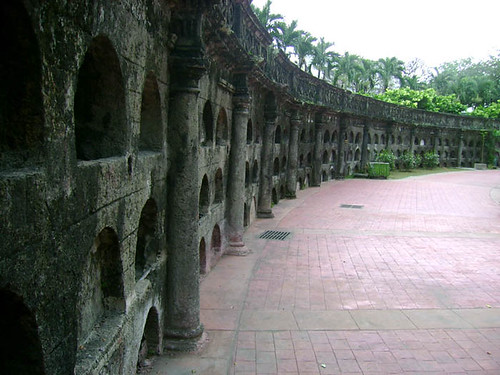
I was curious to find out what Paco Cemetery looks like these days, so I went for short break and visited the serene parque in the heart of Paco. This old burial ground has been transformed into a park for the quiet strolls and is now a preferred location for romantic weddings. This cemetery perhaps is one of the greatest marvels of Spanish engineering and design that still endures today, together with Intramuros, the plazas and the forgotten houses of Spanish colonial Manila.
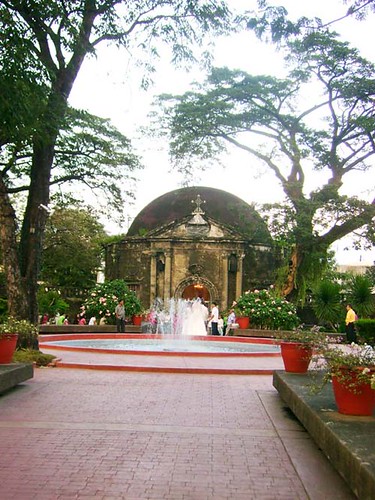
San fernando De Dilaos Cemetery
San Fernando De Dilao's old cemetery

The charge for the entrance is five pesos, yes, that's a steal, everyone can afford it even with our so called economic troubles. The first thing that would greet you are armed security guards [they have these rusty revolvers tucked inside their black leather holsters, they told me that they guard the place against vandals], this I said is a good sign, at least someone's watching over the place.

Memories of Paco

The first time I went to Paco Park was when I was in secondary school, around '95, and back then there were many headstones left, the lawn were well tended, the floras were blossoming, it was healthier then, the trees shelters hi guests from the heat of the sun, the park was breathing, it was still appealing.

[The Burial Walls
The Burial Walls

Today, almost all the lapidas are gone, leaving some graves exposed, while some had been enclosed by cement. The families had already transferred the remains some place, I never really found out why, were they ordered to do so by the Imelda during its transformation?

I heard that some of untaken remains were buried in a common grave, I hope its not true. The headstones should've been brought back to the walls [just like what the Singaporean did in Canning], a custodian there said that they had been lost when the graves were opened. Some of these works of art can still be found in pieces resting on the ground, they were made of the finest marble, the craftsmanship on the embedded letters is exceptional.

Short history of the cemetery that was Paco
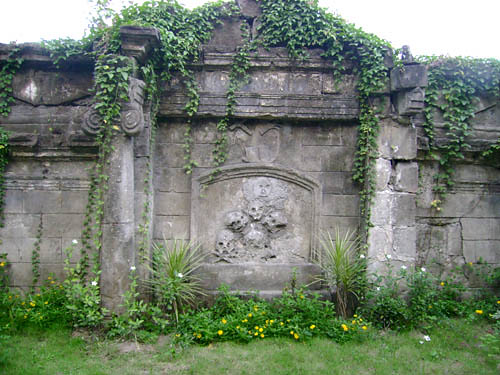
The Osario, burial place dedicated to infants
Burial place dedicated to infant

"in 1807 an administrative order was issued for the construction of a cemetery in Bagumbayan in the town of San fernando De Dilao, commonly known as Paco, near the town of Ermita. Maestro de Obras, Don Nicolas Ruiz prepared the plan, the order was an off shoot of a Cholera epidemic which ravaged Manila in the late 18th century.

the original cemetery was finished on April 22, 1822 although at that time it had already been used for two years. Construction was supervised by a certain Don Jose Coll.

In 1859 then Gov. Fernando de Norzagaray proposed enlarging the cemetery to 4540 varas cuadradas, approximately 4500 square yard, to be enclosed by a circular wall. A Chino Mestizo builder won the contract to build the outer portion of this cemetery for 19,700 pesos. the cemetery used to have a Chaplains and eight caretakers, The Chaplains use to reside across the cemetery on site presently occupied by the Paco Fire Station.

The niches cost 20 pesos for 3 years subject to renewals. No one was allowed to won the niches in perpetuity."

*Governor General Ramon Solano Y Lladeral is interned inside the chapel.

Lapidas, Faith & Espanol!
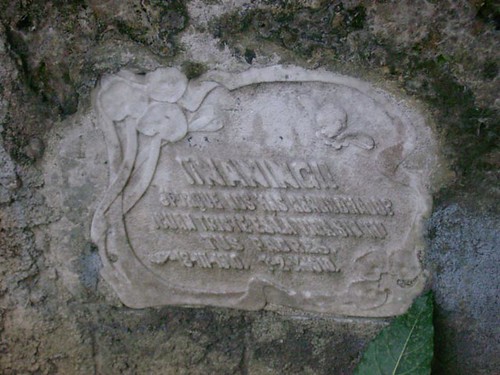
An emotional epitaph from the parents of the dead child, NANING! porque nos has abandonado,  cuan triste es la vida sin tu
An emotional epitaph from the parents of the dead child, "NANING! porque nos has abandonado, cuan triste es la vida sin tu", the parents asking their child why he left them and how sad their lives had become without him."


Back in the older days, what I notice was that all the lapidas were not only arty but had its dedication in pure Spanish, I found it unusual, weren't we "deprived" of learning this language, is it not what we have been taught in school? I did ask my history teacher then [Mrs. Arevalo?], I remember she said something about Catholicism, that there was a connection. Of course there is!

The lapidas in Paco is a demonstration of not only our abiding commitment in the religion that was brought to our shores by the Spaniards, but it also points to the old Filipinos preference for the Spanish as their lengua oficial. Up until the upheaval of 1896, it would be accurate to state that it was the language of the revolution. When you examine the old administrative papers in the archives, you'll instantly noticed that there were no translations to Tagalog or any local language, its either you comprehend what it says, or have someone interpret the words for you, that is how it works - under those conditions even the Filipino Chinese learned Spanish, it was never formally introduced in lower schools [but it has always been part of our higher curricula] until the introduction of the Spanish public school system, yes, but the Filipino's adapted, they had no choice. Spanish was widespread than what is admitted in our English history books which puts the inhabitants communicating in Spanish at a measly 1%[Palanca and Ford had already made a conclusive reports that Spanish is prevalent even among the provincials], but since English was made obligatory by the era of the Yankees, they made it appear that very few, hardly any speaks Castillian, and that it is only right to commence teaching English, this dim justification motivated them to tutor their lil' brown brothers in English. It was here that we slowly drifted away from our Hispanic past.

Now that the lapidas are gradually diminishing, we'll never see how the Filipino of the Spanish period dedicate memorials for their dearly loved friends and relatives. This folks could've been familiar with the lines attributed to Charlemagne, "Spanish is the language with which to speak to God", because otherwise they would've used something else.

The current (mis)administration of Paco

The Paco cemetery of today has been neglected, thanks to the sub agency of the department of tourism for allowing dumb administrators to run the place. When I visited the park, there were shanties inside, yes, tent like dwelling. I requested to speak to whoever was in charge, since I had my bulky camera with me I pretended to be a reporter - he must've bought right into it and even offered me a tour! he said, "Sir, mga tao ko yan, sila ang naglilinis dito saka tumutulong sa pagbabantay sa gabi!", at this point I was contemplating of smashing my camera on his head! what is going on man! what will be your next project, build a mercado inside? or expand your shelter project?

Mr. Peter, I must admit is mild mannered guy, he even divulged to me that they'll be securing around 5 million pesos for rehabilitation, I told him, "I hope you wouldn't tear down the originals", he had this puzzled look on his face, probably asking himself, what would be the use of the 5 million if I can't used it cementing the crumbling adobe walls or maybe painting over it?

Obviously, he haven't encountered the word "restoration" just yet. But I know that any changes would have to get an endorsement from NHI, of which Ambeth Ocampo is chair, so there's hope.

Save our Paco cemetery oh youthful St. Pancratius!

Sunday, January 4, 2009

The ASEAN Rizal (Part 1)

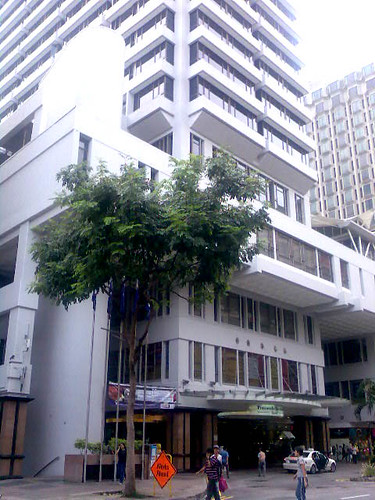
The Peninsula Hotel, Former Site Hotel de la Paix
The Peninsula Hotel, Old site of the Hotel de la Paix

When I arrived here in Singapore, one of the first thing on my "to do list" was to retrace Jose Rizal's footsteps by utilizing his journal entries on May 9 and 10, 1882, his first, and his most significant visit to the islands. I thought that it would be easy, I had in mind an undersized island that I could effortlessly trek within a day, But I was mistaken, it was easier said than done. The City state is a colossal metropolitan, it could be small in land mass but what it lacks in space, it very well compensates in constructing enormous infrastructures, they have roads wider than our expressways, parks that would dwarf our Luneta, a library that's built like a corporate tower, a Ferris wheel that ranks as the world's highest, they even allocated a nature reserve that has more species of trees than that of the entire North American continent. In business school, there is a stratagem that is taught to undergraduates: make small appear Big, this best illustrates the character of the second wealthiest state in Asia.

In the end, I did [I hope] found the places I was looking for, but it took me nearly three weeks! the two raisons why it became time-consuming was, First, Rizal wrote his journal entries without supplying names and exact settings, giving indistinct descriptions, like viewing a "Portuguese church" or entering a "French church", he gave brief commentaries on its appearance but he never revealed any specifics, he was cleanly sketching what he saw, recounting places that he found to be interesting. Second, the colossal land development that has taken place in the last two decades has totally altered the landscape, they did, however, preserved some of the well-known heritage sites and edifices, and they did a splendid job, but the Singapore of 1882, now only exist in B&W photos and old records that can be found in their impressive National Library, the outstanding monuments are but a reminder of what was once a active city harbor of colonial Britain.

Rizal visited Singapore in five occasions, but the first was something special to the brown superman [this was his first ever foreign country visit], for it was here that he begun his pursuit of what he refers to as his "enlightenment", a quest that would take him all over the world and make him the greatest Filipino, in the words of Guerrero, The First Filipino!

We begin our journey with Rizal's rented room at the "Hotel de la Paix", located at Coleman Street, named after Singapore's pioneering city planner, George Coleman. The hotel was in fact the residence of Architect Coleman, constructed in 1829, converted into a lodge after his death. Hotel de la Paix was later renamed Burlington before it was totally demolished in 1965, the contemporary and chic Peninsular hotel, built in 1971, now stand on its place.

According to Marsita Omar, a Singaporean researcher from NLB, "the principal hotels in Singapore in the late 19th century, were Raffles Hotel, Hotel de L'Europe and Hotel de La Paix ". The hotel were Rizal was staying had a fine location, it was pricey but had good quality quarters, but it had terrible service, and the chow according to Rizal, "There was neither order nor coordination in the service...I ate rice which was inferior to ours". Hotel de la Paix sits in the hub of what was recognized then as the island's civic center, amongst its neighbors is the City Hall, Treasury and the Parliament.

In his journal he wrote, "I'm in my room which overlooks a patio adjoining the Hotel Europa, I hear English spoken everywhere...", The Hotel Europa, another classic structure was brought down in 1937, the site was use for the creation of the Supreme Court building, which was finished in 1939.

The old Masonic lodge could also be found in the same street, less than a block away, it's a possibility that he got in touch with his Mason brothers during his short stopover and that they were the ones that prearranged for his boarding in Singapore. Rizal, it seems to me, was already admitted into Masonry long before he came to Spain [this connection however could not be verified, since this ancient fraternity disallows unrestricted disclosures and Rizal never wrote anything about it, older historians believes that he became a Mason in Spain]. It should also be noted that in November 1896, during his last stop in Singapore on board a ship bound to Manila, were he was already in custody as a prisoner, his brothers had lodged a petition for a writ of habeas corpus to save him from being hurled back to Manila, the authorities of Singapore has denied the appeal, the following month he was executed.

He repeated his discontent with the hotel staff as he wrote, "When I returned to the hotel, I waited a long time for supper. At last it came after I had leafed through an illustrated German magazine with beautiful drawings", if he was hotel critic writer, reporting for a travel magazine, he would've failed this hotel, regarded then to be a premier destination.

Rizal was noticeably astonished by what he had been witnessing he wrote, "I'll remember everything I have seen since this afternoon", There were a "thousand enigmatic things" he added, he took pleasure being on the road, but what's worth mentioning is that he never felt at ease with all the oriental culture that surrounded him, he sought for Christian churches and preferred to speak with Spanish speakers. It could very well be the strangeness of the place, far away from the customary sceneries of picturesque Calamba, but then again we should evaluate the established culture of a Filipino, during those years, someone like Rizal, for example, and compare it with other advanced Asian society and we would notice that we had already been hispanized and it would be quite unattainable to alter its effects. Here is Rizal, plainly detached from the preponderance of the Asian way of life. Calling Rizal, a Malay would be improper because aside from his lineage [Chinese and Castillian], he never saw himself as a Malay, on no account did once he declared that he was, but there are many who find it irresistible to associate him with being Malay, chiefly those who sponsors Asianization, believing that culturally, Filipinos belongs to Asia, when it is a historical fact that Asia was never with us.

There were a lot of first for the youthful Pepe, and this is what makes his Singapore experience essential, not only to him but to us, for it was the launching point of his mission to help rid his Filipinas of what he calls its "social cancer". The Rizal that spent that short holiday in Singapore had some dilemma with the language used, his English was awful, could be worst than his Tagalog, and he had trouble conversing with it, although he had already mastered French and his German at this point, English was the foremost language of the island nation [even today] The language barrier could very well be the reason why he never attempted to elaborate and know more about the places he visited, he was merely avoiding the nuisance of inquiring from inhabitants with a "language that they alone can understand".


End of Part 1

Wednesday, December 31, 2008

My New Years Eve and my Hopes for the New Year!

Happy New Year from the Lion City

We woke up early today [Dec 31 2008] to shop for some foodie stuff for the new year celebration later, we Filipinos must have our 'media noche' food [It's not a maligayang bagong taon without it], yes, even in foreign lands we do keep our traditions alive but here they have not heard of the five stars, kuwitis, watusi, sawa and bawang - these explosive devices are our versions of the old Chinese firecrackers, the only difference is, ours is the disfiguring kind.

At the grocery, I purchased the usual rounded fruits [it must be bilog! They will bring me money for 2009, yes!] I remember that these fruits is a must have back home, my mother told me that it represents a bountiful harvest, something that we should be hoping for the next year. I hope it'll do the trick for '09!

Back home I started to cook some pasta, the end product was rather sweet, well, I like nectarous eats anyway so I'm happy with it. I also placed some money on the table for additional luck. With all the troubling news I've been hearing lately, I think we all could use some more [and more!] luck this coming year.

We went to church afterward; it's pretty close to where we live so we left the house at 10:00 for the 11:45 morning mass. Upon reaching the Novena church, I saw countless monobloc chairs, in red and white, scattered all over the place, after the mass it was announced that there will be a pre New Year mass at 2345, I heard that such a celebration is popular here.

For this final day of 2008, I prayed for our nation to heal, right now we are broken but I have no doubt in my heart that we will improve, yes, life's getting hard for the average Filipino; it's getting tough out there but if we could work together and look out for each other, things will get better!

For 2008 and 2009:

It was this year that I started to blog, I never really thought that I would be running the site this long but I really enjoy writing here and seeing many people visit the site is flattering, even if they end up disliking the stuff that I post [including my faulty grammars and misspelled words!], it makes no difference to me, I consider them all my friends! I wish everyone here the best!

Peace!

I wish everyone a happy new year, the prospect for the year 2009 they say is not good, but what the heck, nothing gets in the way of the Filipino! We are the happiest people on the earth! They say that jobs would be lost [and all the blah blah's], the heck! I have a friend that doesn't even have the job, never had one since we graduated 2003! And he's happy! Living with his mom and dad. Moral lesson is enjoy life, the challenge is finding happiness, finding joy, ending our hateful ways!

Let's be happy, Filipino!

Happiness and Prosperity!

Prospero Nuevo Ano!

Saturday, December 27, 2008

Filipinos Lack of National Pride and Identity

This article was written by an American, Barth Suretsky. His observations are interesting and his comments about our culture and his respect and love of the Philippines are nicely written. Due to the worsening situation in our country, let's hope this will make an impact on other Filipinos who read it...

BE PROUD TO BE A FILIPINO

My decision to move to Manila was not a precipitous one. I used to work in New York as an outside agent for PAL, and have been coming to the Philippines since August, 1982. I was so impressed with the country, and with the interesting people I met, some of which have become very close friends to this day, that I asked for and was granted a year's sabbatical from my teaching job in order to live in the Philippines. I arrived here on August 21, 1983, several hours after Ninoy Aquino was shot, and remained here until June of 1984.

During that year I visited many parts of the country, from as far north as Laoag to as far south as Zamboanga, and including Palawan. I became deeply immersed in the history and culture of the archipelago, and an avid collector of tribal antiquities from both northern Luzon, and Mindanao.

In subsequent years I visited the Philippines in 1985, 1987, and 1991, before deciding to move here permanently in 1998. I love this country, but not uncritically, and that is the purpose of this article. First, however, I will say that I would not consider living anywhere else in Asia, no matter how attractive certain aspects of other neighboring countries may be. To begin with, and this is most important, with all its faults, the Philippines is still a democracy, more so than any other nation in Southeast Asia.

Despite gross corruption, the legal system generally works, and if ever confronted with having to employ it, I would feel much more safe trusting the courts here than in any other place in the surrounding area. The press here is unquestionably the most unfettered and freewheeling in Asia, and I do not believe that is hyperbole in any way! And if any one thing can be used as a yardstick to measure the extent of the democratic process in any given country in the world, it is the extent to which the press is free.

But the Philippines is a flawed democracy nevertheless, and the flaws are deeply rooted in the Philippine psyche. I will elaborate... The basic problem seems to me, after many years of observation, to be a national inferiority complex, a disturbing lack of pride in being Filipino.

Toward the end of April I spent eight days in Vietnam, visiting Hanoi, Hue, and Ho Chi Minh City. I am certainly no expert on Vietnam, but what I saw could not be denied: I saw a country ravaged as no other country has been in this century by thirty years of continuous and incredibly barbaric warfare. When the Vietnam War ended in April, 1975, the country was totally devastated. Yet in the past twenty-five years the nation has healed and rebuilt itself almost miraculously!

The countryside has been replanted and reforested. Hanoi and HCMC have been beautifully restored. The opera house in Hanoi is a splendid restoration of the original, modeled after the Opera in Paris, and the gorgeous Second Empire theater, on the main square of HCMC is as it was when built by the French a century ago. The streets are tree-lined, clean, and conducive for strolling. Cafes in the French style proliferate on the wide boulevards of HCMC. I am not praising the government of Vietnam, which still has a long way to travel on the road to democracy, but I do praise, and praise unstintingly, the pride of the Vietnamese people. It is due to this pride in being Vietnamese that has enabled its citizenry to undertake the miracle of restoration that I have described above. When I returned to Manila I became so depressed that I was actually physically ill for days thereafter. Why?

Well, let's go back to a period when the Philippines resembled the Vietnam of 1975. It was 1945, the end of World War II, and Manila, as well as many other cities, lay in ruins. (As a matter of fact, it maynot be generally known, but Manila was the second most destroyed city in the entire war; only Warsaw was more demolished!) But to compare Manila in 1970, twenty-five years after the end of the war, with HCMC, twenty-five years after the end of its war, is a sad exercise indeed. Far from restoring the city to its former glory, by 1970 Manila was well on its way to being the most tawdry city in Southeast Asia. And since that time the situation has deteriorated alarmingly. We have a city full of street people, beggars, and squatters. We have a city that floods sections whenever there is a rainstorm, and that loses electricity with every clap of thunder. We have a city full of potholes, and on these un-repaired roads we have a traffic situation second to none in the world for sheer unmanageability. We have rude drivers, taxis that routinely refuse to take passengers because of "many trapik!" The roads are also cursed with pollution-spewing buses in disreputable states of repair, and that ultimate anachronism, the jeepney! We have an educational system that allows children to attend schools without desks or books to accommodate them. Teachers, even college professors, are paid salaries so disgracefully low that it's a wonder that anyone would want to go into the teaching profession in the first place. We have a war in Mindanao that nobody seems to have a clue how to settle. The only policy to deal with the war seems to be to react to what happens daily, with no long range plan whatever. I could go on and on, but it is an endeavor so filled with futility that it hurts me to go on. It hurts me because, in spite of everything, I love the Philippines.

Maybe it will sound simplistic, but to go back to what I said above, it is my unshakable belief that the fundamental thing wrong with this country is a lack of pride in being Filipino. A friend once remarked
to me, laconically: "All Filipinos want to be something else. The poor ones want to be American, and the rich ones all want to be Spaniards. Nobody wants to be Filipino." That statement would appear to be a rather simplistic one, and perhaps it is. However, I know one Filipino who refuses to enter a theater until the national anthem has stopped being played because he doesn't want to honor his own country, and I know another one who thinks that history stopped dead in 1898 when the Spaniards departed! While it is certainly true that these represent extreme examples of national denial, the truth is not a pretty picture. Filipinos tend to worship, almost slavishly, everything foreign. If it comes from Italy or France it has to be better than anything made here. If the idea is American or German it has to be superior to anything that Filipinos can think up for themselves. Foreigners are looked up to and idolized. Foreigners can go anywhere without question. In my own personal experience I remember attending recently an affair at a major museum here. I had forgotten to bring my invitation. But while Filipinos entering the museum were checked for invitations, I was simply waived through.

This sort of thing happens so often here that it just accepted routine. All of these things, the illogical respect given to foreigners simply because they are not Filipinos, the distrust and even disrespect shown to any homegrown merchandise, the neglect of anything Philippine, the rudeness of taxi drivers, the ill-manners shown by many Filipinos are all symptomatic of a lack of self-love, of respect for and love of the country in which they were born, and worst of all, a static mind-set in regard to finding ways to improve the situation.

Most Filipinos, when confronted with evidence of governmental corruption, political chicanery, or gross exploitation on the part of the business community, simply shrug their shoulders, mutter "bahala na," and let it go at that. It is an oversimplification to say this, but it is not without a grain of truth to say that Filipinos feel downtrodden because they allow themselves to feel downtrodden. No pride. One of the most egregious examples of this lack of pride, this uncaring attitude to their own past or past culture, is the wretched state of surviving architectural landmarks in Manila and elsewhere.During the American period many beautiful and imposing buildings were built, in what we now call the "art deco" style (although, incidentally, that was not a contemporary term; it was coined only in
the 1960s). These were beautiful edifices, mostly erected during, or just before, the Commonwealth period. Three, which are still standing, are the Jai Alai Building, the Metropolitan Theater, and the Rizal Stadium. Fortunately, due to the truly noble efforts of my friend John Silva, the Jai Alai Building will now be saved. But unless something is done to the most beautiful and original of these three masterpieces of pre-war Philippine architecture, the Metropolitan Theater, it will disintegrate. The Rizal Stadium is in equally wretched shape. When the wreckers' ball destroyed Frank Lloyd Wright's Imperial Hotel in Tokyo, and New York City's most magnificent building,  Pennsylvania Station, both in 1963, Ada Louise Huxtable, then the architectural critic of The New York Times, wrote:

"A disposable culture loses the right to call itself a civilization at all!" How right she was! (Fortunately, the destruction of Pennsylvania Station proved to be the sacrificial catalyst that resulted in the creation of New York's Landmark Commission. Would that such a commission be created for Manila...)

Are there historical reasons for this lack of national pride? We can say that until the arrival of the Spaniards there was no sense of a unified archipelago constituted as one country. True. We can also say that the high cultures of other nations in the region seemed, unfortunately, to have bypassed the Philippines; there are no Angkors, no Ayuttayas, no Borobudurs. True. Centuries of contact with the high cultures" of the Khmers and the Chinese had, except for the proliferation of Song dynasty pottery found throughout the archipelago, no noticeable effect. True. But all that aside, what was here? To begin with, the ancient rice terraces, now threatened with disintegration, incidentally, was an incredible feat of engineering for so-called "primitive" people. As a matter of fact, when I first saw them in 1984, I was almost as awe-stricken as I was when I first laid eyes on the astonishing Inca city of Machu Picchu, high in the

Peruvian Andes. The degree of artistry exhibited by the various tribes of the cordillera of Luzon is testimony to a remarkable culture, second to none in the Southeast Asian region. As for Mindanao, at the other end of the archipelago, an equally high degree of artistry has been manifest for centuries in woodcarving, weaving and metalwork. However, the most shocking aspect of this lack of national pride, even identity, endemic in the average Filipino, is the appalling ignorance of the history of the archipelago since unified by Spain and named Filipinas. The remarkable stories concerning the Galleon de Manila, the courageous repulsion of Dutch and British invaders from the 16th through the 18th centuries, even the origins of the Independence movement of the late 19th century, are hardly known by the average Filipino in any meaningful way. And thanks to fifty years of American brainwashing, it is few and far between the number of Filipinos who really know - or even care - about the duplicity employed by the

Americans and Spaniards to sell out and make meaningless the very independent state that Aguinaldo declared on June 12, 1898. A people without a sense of history is a people doomed to be unaware of their own identity. It is sad to say, but true, that the vast majority of Filipinos fall category. Without a sense of who you are how can you possibly take any pride in who you are?

These are not oversimplifications. On the contrary, these are the root problems of the Philippine inferiority complex referred to above. Until the Filipino takes pride in being Filipino these ills of the soul will never be cured.If what I have written here can help, even in the smallest way, to make the Filipino aware of just who he is, who he was, and who he can be, I will be one happy expat indeed!

---


Thanks to Liz Medina for sharing this.

Pampanga honors Augustinian legacies

By Tonette Orejas
Inquirer


CITY OF SAN FERNANDO-Kapampangans filled the San Agustin Church and its nearby museum in Intramuros, Manila, on the night of Aug. 24 to pay tribute to Augustinian missionaries who had sailed from there to Pampanga 435 years ago and influenced the natives' character, culture and history.

As they stood on the same grounds where some of those 100 friars lived and trained, they bridged the time, seeing past and present connections between Fray Juan Gallegos, who set foot in Lubao in 1572, and far, far, far down time when Fr. Eddie Panlilio, who finished theology at the St. Augustine Major Seminary, was elected governor in 2007.

"Holy ground," was how Dr. Arlyn Villanueva, president of the Holy Angel University, called the event's venue.

By the way the tribute and the celebration of continuing collaboration turned out, it was apparent the people wanted to remember the Augustinian fathers beyond their white robes and emblems of a flaming heart.

Their "enduring legacies" are the Roman Catholic faith and values, heritage churches and architectural knowledge, schools and education initiatives, publications that chronicled the language and culture, ecclesiastical arts and culinary tradition, said San Fernando Archbishop Paciano Aniceto at the Mass he celebrated with Bishop Roberto Mallari and eight priests.

Other legacies are the archival documents, the solidarity of friars with the faithful in times of wars, calamities and epidemics, the opening of roads, and their engineering attempts to provide irrigation to farmers.

The extent of the Augustinians' work and the breadth of their influence spoke of the fervor with which the pioneers lived out the dictum of their founder, St. Augustine, that "our hearts are restless until they rest in (God)," said Fray Francisco Musni, archivist and researcher of the HAU's Center for Kapampangan Studies, which organized the tribute.

Aniceto said the Archdiocese of San Fernando was "most profoundly grateful for the gift of faith" because it steeled the people in adverse times like Mt. Pinatubo's 1991 eruptions and the lahar flows that followed.

That gift, he said, flourished because several Kapampangan, like Rufino Cardinal Santos, the first Filipino cardinal, became church pioneers themselves.

In gratitude, the provincial board presented a copy of Resolution No. 945 to Fr. William Araña, OSA, vicar of the Orient of the Philippines, Augustinian Province, and to Alvaro Trejo, charge d'affaires of the Spanish Embassy.

The resolution gives "due recognition and honor to the friar missionaries of the Calced Order of Saint Augustine for their pioneering efforts in Pampanga and for their role in the preservation of the culture."

That made Pampanga, the first and last Augustinian territory in Luzon until 1960, to be the "first province in the Philippines to officially thank the Spanish missionaries who labored in the country during colonial times," said Robby Tantingco, the center's executive director.

One of the high points was the launch of the English translations of Fray Diego Bergaño's two books, the "Arte de la Lengua Pampanga" (1729 Kapampangan Grammar) and the "Vocabulario de Pampango" (1732 Kapampangan Dictionary).

Bergaño and his collaborator then, Don Juan Zuñiga of Mexico town, managed to reach out to the present through the translations of Fr. Edilberto Santos and Fr. Venancio Samson.

Friday, December 26, 2008

Fort Canning's Hidden Tombstones


One of my favourite places to visit are old cemeteries, yes, eternal homes, memorial parks [whatever it's called these days], I find it ironic that these places which have markers dedicated for the dead could tell us  a lot about life, well, the life lived by its residents that is. In the gravestones that I found, not only contain the usual information we  see back home, like, where they were born and date that they died, some of the epitaphs also presented information's on the deceased trade or profession, affiliations, names of their ship, their lineage and other more, it was strange but never the less, very interesting, you're like reading a posthumous resume. Some had more than one language inscribed; it was an impressive memorial considering that most of these gravestones have been around for almost two hundred years.

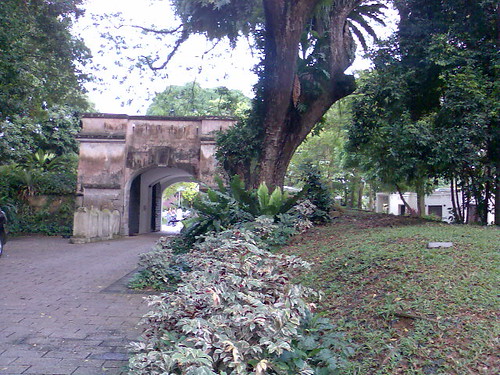
Established in 1823, the cemetery served mainly Protestants and Catholics. There are two majestic arches that in a way resembles that of the gates of Intramuros, it has the initial IHS, the first three letters of the name Jesus in Greek. In mid 1800's the site no longer could accommodate burials, the cemetery was permanently closed, there were several attempts to have it reopened, however none were authorized. In the 1950's a significant number of gravestones were removed [to free up space?], the few remaining stone memorials where fixed to the cemetery walls.

Today, one could enjoy a leisurely walk in this peaceful nature park while enjoying the natural scenes and viewing the old tombstones. It was a cloudless afternoon, the sun was exposed, but the trees were countless, they kept the place cool and misty. Up in the hill, behind the elevated white hill house, which looks like the Malacanan from a distance [now cultural theatre and venue], I witnessed a regal wedding in an area that call to mind our charming Paco cemetery [now also a park], they were the moneyed class here [mga mapera!] all the parked cars on the cemented pavement were luxury cars [cars that I usually see on posters with half naked female models], everything looked extravagant, I hang around for awhile and listened to an acoustic duo that serenaded the newlyweds.

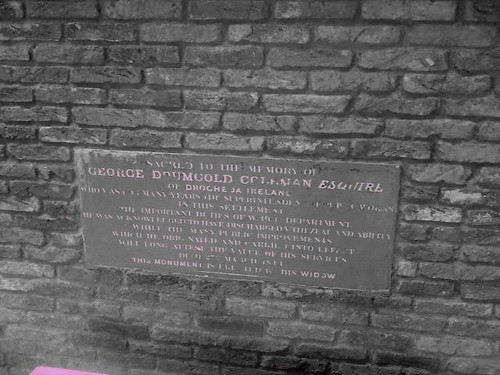
One of the famous residents of the this old Christian cemetery is George Coleman [not Foreman the boxer], the famed Irish architect, credited to have given Singapore its first beautiful buildings, like the first Government house, St. Andrews, Parliament, Raffles Institute and the Armenian Church. He also built this structures called Cupolas, right in the middle of the cemetery, probably a place built as a shed but it's too small and could only accommodate few people, maybe two - I believe that this structures where built for the spirits [his and his wife] its an odd structure, this is the first time I've seen one.

Coleman would be Burnham to Singaporeans, he's credited to have given Singapore its true English buildings. It was said that the first Catholic Church in Singapore was originally designed by him; however, it was not approved because  of financial issues.


Coleman was also commissioned by Raffles to several jobs including overseeing convict labours and surveying the many islands, but he's best remembered for his contribution in architecture. His tombstone was dedicated by his wife, it was an impressive and very well made gravestone, the Singapore historical commision as placed a metal marker, so people could easily spot the grave. Mrs. Coleman would later marry a man named James Napier, said to be the first Law agent in the straits settlements, she would dedicate another grand memorial tomb here  later on, but this time to her son with Napier, James Brooke Napier , their prominence can be seen in the graceful memorial head stones that still stands in the cemetery hill.


Coleman's house [the street was renamed after him] , which is near the old cemetery was converted into a hotel long after he died, it is now where the Peninsula hotel stands. The Coleman house could be the hotel where Rizal stayed, however, I could not find anything that could substantiate this, although I'm certain that the area where Peninsula hotel now is where Rizal's Hotel de la Paix was located. Whether it was Coleman's house that became the hotel later on is still a question to me, I have yet to see a map or something to find out if they were the same.

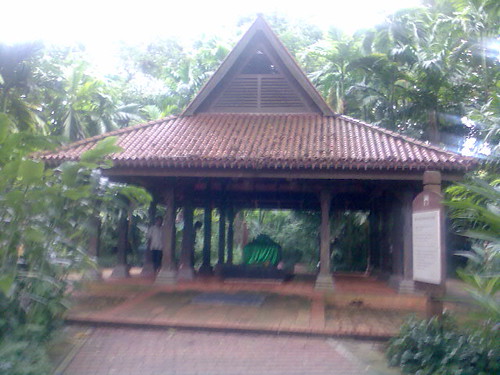
Somewhere in the hill, I stumbled upon a small house made of solid timber, there was a centrepiece that was covered in silky clothe, it was adorned with fresh flowers and some fragrant object, the place is said to be the final resting place of the last king of Malaya, he was a Muslim Rajah, the Malay people revered him. I saw there some people cleaning the wooden floor. The house is traditionally built like the wooden houses that can be found in Mindanao. The place is known to Malay as Bukit Larangan, the word Bukit is where our Bukid originated, Larangan to Malay is forbidden, for us I believe it means 'field'. For years they have considered the hill a no entry zone, of course when the British came that all changed. Raffles built his house on the hill, he once wrote a friend that he would not mind being buried alongside the Malayan king, however, it is yet unproven if the great Rajah was indeed buried on his hill, since it was recorded that he died in Malaca. There were an excavation that was carried out and they had found eveidence that could prove that the hill was the site of Iskandar Shah.


I saw people cleaning the wooden house, scrubbing it [binubunot] they must be the assigned cleaners, which reminds me of my grade school years where school children were assigned to be cleaners depending on the day, mine is usually Monday since my last name start with an A. The wooden house has striking similarity to the Mindanaoan wooden houses, it was humble yet poetic, it has a pointed edge on its roof, it's open on all sides and there were people kneeling on its hard wood parquet. I did not bother to enter and take pictures; I don't want to disturb what there were doing inside. I took a picture from a distant and moved on.

There is so much to see in this hill, there's a botanical garden, it has hundreds of plants with name plates on it. It was said that Raffles also had ordered spices to be planted for studies and future plans of making  them steady agricultural produce. Unlike Magellan or Legazpi, who has been succesfully demonized in our popular history, this man Raffles seems to enjoy a rock star stature here, he's regarded as the founder of the modern Singapore, when he claimed the island for the English empire. One could go around his garden and find exotic plants, plants that I have never seen even in books, I did however found Kamias, I wanted to take some home for sinigang but I decided not to, I might get fined, they don't call this country the Fine city for nothing. Sinigang by the way is Malay in origin.

I noticed a tombstone that I believe belongs to an Armenian, on it, the birthplace written was "Manila", Filipinos had great ports then in Spanish Manila - migration was extensive even then. Another had the Masonic emblem on it, actually I've seen several around - they must've been really devout and proud members of that secret society. I also saw Star of David symbol, turns out that they had a healthy Jewish population then, Jewish were very influential in the islands - I remember this ambassador to France, I believe he was Singapore's first non Oriental high ranking diplomat. I also discovered interesting are the angels carved in marbles, they were like jewels, they look as if they have just been made recently.

There was this tombstone that was dedicated by the officers and crew member of a US Navy ship, they probably buried their fallen comrade here for practical reasons,  a voyage back to midland US is a distant transit, so he was laid to rest here in a tropical island. Everywhere I find curious epitaphs, some had expressive verses, other were plain, providing only the names and life in years.

Even on a hot day, the climate remained cool, thanks to the rainforest like vegetation, I stayed in the area for three hours, wandering around and occasionally taking breathers in between, hiding beneath the shades of the hills mighty trees. I'm sure going to look for old burial places back home, who's with me?

Wednesday, December 24, 2008

The Prewar Intramuros

If youre a history junky chances are you've already seen this video by an American journalist taken before the war.

I need not say more... precioso!


Another video called, "Manila - Castillian Memories"

[youtube=http://nz.youtube.com/watch?v=ZOI6rc38Qic&feature=channel]