Showing posts with label bahay na bato and other traditional Filipino architectu. Show all posts

Monday, October 27, 2008

Sanctuario de San Pedro Bautista

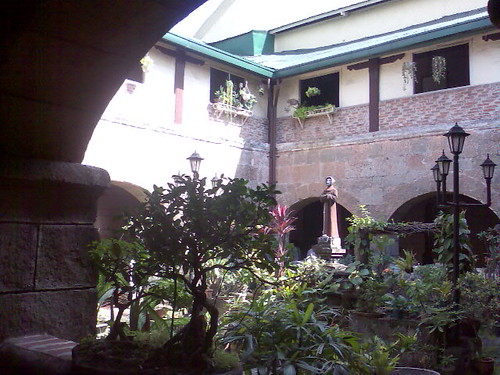
The Franciscan Garden


Just when you thought that Quezon City has nothing to offer but the metro feel, top schools, colossal malls and trendy subdivisions, think again.

When you reflect on the old Filipinas what comes to mind is Manila and the well-known  provincia's (Vigan, Taal etc) but rarely someone would think of Quezon City as having something similar to the grand old churches and casa's of this enchanted Filipino Spanish towns.
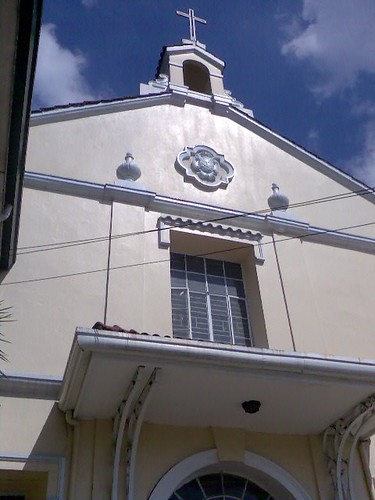
The new fascade of the ol Iglesia
The new fascade of the ol' Iglesia (it still stands on the original foundations of the first church, the rearrangement and renovations has drastically altered the first church)


Well, of course there are fine historical sites in Quezon City, I've always wanted to visit President Quezon's final resting place in Quezon circle but never had the time (or find not to have time). In Bagong Silang you have the site of the "Battle of San Mateo", Pugad Lawin and the Tandang Sora Shrine, just to name a few.

But the most amazing discovery I made recently was the Franciscan church in San Francisco del Monte, and it was a wonderful discovery. For hundreds of years it has served its dominion, not only establishing Christianity, which it has successfully completed but also introduce arts, like music. The town organizer and church builder, San Juan was a gifted musician.

Driving from Manila via España to Quezon City most of the times is a taxing charge(especially if your from the south metro), passing through this major roads are always better during the weekends. I thought for awhile that Sr.Gomez would take us to Santo Domingo, the church that was originally built in Manila but was later relocated because of its demolition during the American's unrelenting offensive of Manila (Liberation?). The La Naval de Manila (in Quezon City?) culture lost its continuity - but there must be some divine explanation we don't know that would explain why, the old site I believe is where BPI now stand in Intramuros.

Going back to this goldmine of a discovery, we headed to the San Francisco del Monte Church and was welcomed by its historical markers, appraising it made me appreciate that I was in one of the oldest church in this once Spanish province, here, in the heart of the metropolis.
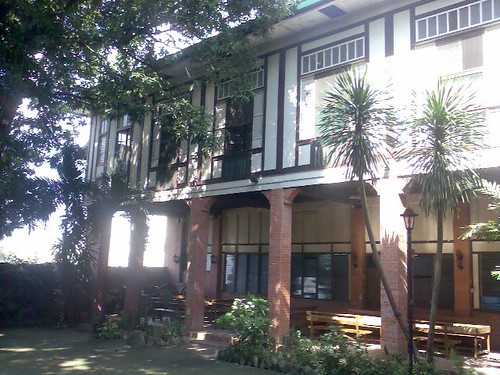
The Antillan
The Antillan
I found this brief history of the place and its venerated Spaniard saint, San Pedro Bautista & his Iglesia.
Pedro Bautista Blasquez arrived in 1584 with the 4th group of Franciscan Missionaries to the Philippines, was not an inexperienced man. He was 42 years old who acquired fame as a preacher in the cathedral of Toledo, Spain. He taught philosophy for three years in Madrid and was an excellent musician. He arrived as the head of the mission and was to preside as the chapter of custody. In a word he was a mature man, educated, experienced and placed in a position of authority.


The fourth Chapter of Custody and the first after the arrival of Pedro Baustista was held in the convent of Manila on September 24, 1584. The conference elected Pedro Bautista, Custos of Superiors of all Franciscans in the Philippines.


Apparently he preferred not to accept the position of authority. After the election Fray Pedro hid and only later when his brethren refused to accept his resignation did he took the position. That was in 1588. having accepted the responsibility he put himself dynamically into his work. He animated his religious to live out their profession and to care the conversion of others. To encourage them he learnt the language of the natives. He counseled his Friars living at a distance and encouraged them with his letters worthy of a holy man.

Because of his  deep concern for the spiritual welfare of his friars, Pedro Bautista saw the need for a secluded place where the missionaries, true to reform spirit of their province, could revive their spiritual vigor by prayer, reflection and discipline. After a long search, he selected a site a little over a league from Manila.


On February 15, 1590 Gov. Santiago De Vera donated "Una Pequeña Encomienda", an estate of some 150 hectares to the Franciscans: Pedro Bautista immediately ordered the construction of a small  bamboo  and nipa convent and church under  the title of Nuestra Señora de Montecelli, which however, was popularly known from the very beginnings of "San Francisco Del Monte".


It was opened as a retreat for missionaries and as a novitiate house from 1580 the novitiate had been in San Francisco De Manila but the noise of the city and the coming and going of the friars to the Provincia headquarters made it less than appropriate for contemplation. The first profession recorded in San Francisco Del Monte took place in December of 1591.

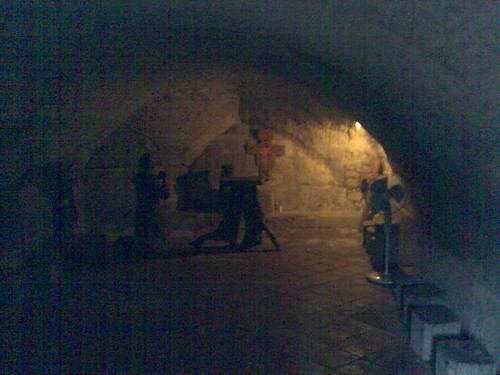
The cave for prayers (yes, this guys are pretty serious with their prayers that they dugged a cave for their praying rituals)
The cave for prayers (yes, this guys are pretty serious with their prayers that they dug a cave where they can pray in complete silence)


In 1699, a church was made of stone was built and the convent restructured. This was dedicated t the newly beatified Blessed Pedro Bautista and his companion martyrs. This church had now become the sanctuary with the Baroque altar that is still preserved today.


In 1895, the friars abandoned the lace and Filipino revolutionary forces occupied the church. In 1898, American Negro soldiers of the occupued the church. the church was left idle until it was repaired in 1912. In 1914, the Church was blessed and a town fiesta was held in honor of San Pedro Bautista.


On November 11, 1932, the Church was declared a parish name in honor of its founder and patron saint, San Pedro Bautista, before the decree, the parish belonged to the parish of Caloocan.


In 1989, the three century old baroque altar was transferred to the main sanctuary. In 1990, a statue of San Pedro Bautista was enshrined at the center of the altar. One February 5, 1997, the parish marked the 400th anniversary f the Martyrdom of San Pedro Bautista. On February 25, 2007  the parish church was declared an  archdiocesan shrine to be known as Sanctuario de San Pedro Bautista in view of its monasterical and religious significance.


After a successful effort from Padre Gobo left for Manila but he was lost at sea. Gov. Dasmariñnas waited one futile year for his return then decided to send Pedro bautista as his new ambassador. brother Gonzalo Garcia who knew Japanese very well was designated as the new emissary's interpreter; tow other completed the group. after his diplomatic mission Pedro Bautista was to stay on as the permanent representative of the Governor of Manila and labor for the conversion of the Japanese.


That was the plan of the Governor but the "Superior of the Jesuits in Manila" reminded him of the prohibition of Gregory XIII. The Governor called a meeting at the church of San Agustin on May 18, 1593 to discuss with the prominent theologian and authorities what could be done. The outcome was his firm decision to send Bautista's party.


On May 30, 1593 Pedro Bautista and his companions sailed for Japan, their new work and eventually their martyrdom four years later.


Continuing  the policy of his famous predecessor Fray Juan de Placentia, "The Father of Reductions", San Pedro worked to gather  the native of the towns. In Morong, he obliged the numerous rancherias spread throughout the mountains to form the "Doctrinea" of Morong. He was the moving spirit behind the behind the foundation of many towns. In Camarines: Quipayo, Cagsawa, Baac, Oas, Libmanan and Buhi. In Laguna - Rizal area: Tanay, Baras, Longos and Paquil. And in Bulacan: Catangala (Polo). He likewise started churches and convents of Meycuayan and Calilay, centers in the days of Bulacan and Tayabas.

It was a great experience walking around, seeing people celebrate mass on a Sunday, thinking that Catholic tradition here is almost as old as the founding of the walled city, it was alive, surviving the wars (both sectarian and military conflicts). The place is a legacy of the Catholic missionaries. It reminded me how it all happened, the religion and the country.

One of the most interesting historical facts that were not taught in schools is that this Catholic missions, founded almost all of our old towns, paving the way to unanimity, inspiring the shape of the islands into what we know now as the Philippine Islands, christianization and domination, and perhaps its unseen and under valued gift, our identity.

As I was walking along the Franciscan garden I tried to visualize what it was like living their lives, far away from their beautiful mother country, the endless prayers and the remote, often, perilous missions to convert, some say we never desired their interference and Christian convertion but we still remain transformed Katoliko's anyway, to say now that 'all Friars' - are wicked and that they corrupted us, is plainly erroneous.

Let's give credit, where credit is due

...speaking of credits, this two brought me here.

...speaking of credits, this two brought me here.

Gracias, mis amigos...
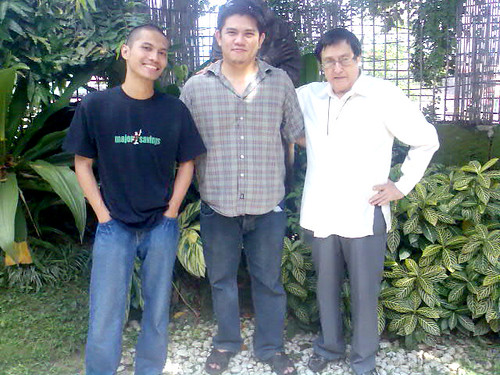
Pepito, me & the man, the legend GGR
Saturday, August 9, 2008

Save Quiapo!

Isn't this beautiful! a church at the end of the road!

I was reading my round of blogsites the other day when I stumbled upon this cry for help to save Quiapo's Calle Hidalgo from one of the more popular blogger around Carlos.


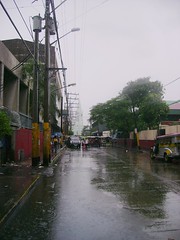
Ironically, just last week I visited this place, but due to heavy rains I didn't notice that there was a four storey condominium being built along the street, as of this writing, according to a friend they have started digging, soon I'm definite that they would commence laying the concrete foundations.


Hidalgo is still one of my favorite streets of Manila, I'll never forget seeing this place for the first time when I was in grade school. My Tia Lydia brought me to the steps San Sebastian, I was awed by its beauty. It was so perfect, from Quezon if one would walk; the church would be visible at the end of the road. At the end of the long thread, the steel church awaits - what a reward! I can only imagine how beautiful this place was, back in the old days.


It is quite obvious that Quiapo has slowly deteriorated due to neglect, but it's never too late. ‘The heart of Manila' according toProf. Zialcita (subtitle of his book Quiapo) still has the potential - the beautiful houses are still there!


The Paterno (I hope I got this right)
The Paterno house (not 100% sure though) when I tried to speak with the people who resides inside, all I got were blank stares.

I dream one day that I can bring along foreigners and show them how great Manila was, and how it protected its heritage while progressing into a first class city, through Quiapo.


Looking at David's map the building would be built between the Ocampo and Paterno houses, which would make it out of place, worst this would congest the already heavy foot and vehicle traffic, they should keep in mind that there are schools on that street (MLQU being one of them with a very substantial student population). If there's one thing that the city government of Manila does not have,  is the appreciation for these historic places - they just don't take the value of heritage into consideration when they allow private constructions, is it all money? la avaricia para el dinero!


This could be the Ocampo house. If only we could restore this houses!

When you look at countries like Singapore, Malaysia and even communist Vietnam, you would notice that they take pride in their colonial houses, you would not see them destroy this relics, instead they would put efforts to restore them - why can't we do the same?


In time, this houses that represents the glorious past would be gone, lost forever. That is why I usually would walk tirelessly, taking photographs of old houses and places, I would want to save them even in pictures - because at this moment, everything seems to be fading away and were not getting that much from our government.


---


Please visit this site (click here) and be part of a signature campaign to stop this condominium construction that would not only destroy the historic corridors of Hidalgo, but would worsen the traffic situation! I don't understand why Mayor Lim gave the green lights for this, I should not be surprise anymore, what's new!

Saturday, June 28, 2008

As we close the month of June

I would be switching to a new blog design, hopefully my visitors (I believe most are friends and relatives!) will like the new look.

The reason for the change is that the old platform does not provide that many widgets. This are the stuff that makes the site more accessible and easier to navigate.

Plus I wanted to personalize the banner(yes, I'm some sort of a 'digital artist', I make banners for free!); green is the theme, it symbolize the nation. The silhouette of my contemplative walk, tells of my attempt to review our real past.


Overall the site should be better than the last one. I love the look of the last design because it was simple, but I guess I'm sticking with this new thing.

I was teased by a friend, he was sarcastically asking if people are reading blogs with topics like 'Rizal' & 'Bahay na Bato' etc etc... you would be surprised my friend that there are people who actually do! they are not in the millions, but I hope they would increase in number in the future.

I just want to up the awareness level, it does not really matter to me if I do it one mind at a time. As long as there's someone interested in reading my take on our history, I'm good with that.

For the last 3 months that I've been uploading entries regularly I had some decent numbers here, they are pretty small but I'm happy with this petite figures. I think a little over a thousand visitors (hits), I'm not sure if wordpress is counting my visits, if yes I might have accounted for the half of it!

I'm happy to see the increasing numbers of travel blogs, this bloggers are contributing in their very creative ways in promoting our historical sites, which is very admirable. I've actually gone out on excursions after reading some this blogs, they are truly inspiring. That's the power of one, my friends.

Naturally, if people are aware of a structures historical value they tend to look after it, which is what, I think, everybody wants. I don't consider mine a travel blog (I've been ranting this past few days about stuff as you can see) since I rarely travel due to lack of funds and time, but let me tell you that traveling around would've been more difficult without this travel blogs.

More to come in the coming months! God bless y 'all!

Tuesday, May 6, 2008

San Juan Bautista Church in Calamba


A brief history of this historic Iglesia we recently had the chance to visit last month.

Considered by our local church official as one of the 'jubilee churches'(old pre Spanish churches in Laguna) alongside with the shrine of Sto. Sepulcro in Landayan, SanPedro and the other old century old churches in Laguna (Nagcarlan, Pila, San Pablo, Mabitac, Paete, Pangil, Pakil, Pagsanjan, Majayjay...)
In 1759 the Jesuit Missionaries purchased a big portion of land called Hacienda de San Juan, but the parish was established only in 1779 by the Franciscan Friars.

In this church, Fray Rufino Collantes baptized our national hero, Dr. Jose P. Rizal, on June 22, 1861. the original altar was burned in 1862 but immediately rebuilt by Fray Leoncio Lopez. the first Filipino priest, Fr. Angel Villaruz, served this church for 43 years since 1901. the incumbent Parish Priest is Fr. Menorca.

This church was literally just a stone throw away from the Rizal residence, I was told by a friend that its original location was in the front of the Rizal shrine before -I was not able to verify this but there was what looks like old pre-Spanish foundations where the current vidokes, sari sari stores and carinderia is located, all this establishments fronting the shrine, what an eyesore.

I'm quite intrigue by the piece of a scanned document that hangs in the wall inside the Rizal shrine which declares Father Lopez as the signatoree of Rizal's birth certificate when it was in fact a different friar who conducted the baptism, Fray Collantes. I also heard that Rizalista's makes a connection of Rizal being baptized here in the church of San Juan Bautista, comparing it to Jesus undergoing the same rites under his cousin San Juan Bautista, they took it for its divine meaning -as if Rizal was baptize by St. John himself. I really can't blame this people, Rizal is a fascinating man, aside from his intellectual feats it seems that this renaissance of a man is a clairvoyant - based on what I've read about him this man is a believer in the supernatural, very pinoy - very superstitious.

This church has been the center of the activity of the town - like fiestas and other town functions. This is the genius of the Spanish city planning, every town built around an Iglesia or convento, it seems that all roads will lead you back to the church, a poblacion is never without a great Iglesia. Calamba's town and this church has been conceived the same way - bringing the people closer to God and the town's government.

Wednesday, April 16, 2008

The Alberto house in Biñan


Alberto - Alonzo House, originally uploaded by Arnaldos' shutter.

In a recent visit to the Alberto house in Biñan. I was awed by its beauty but at the same time regret its present condition. This classic stone house displayed the prominence and style of the family that once lived here. You could feel by observing the house that the occupants are no ordinary Filipinos add to this is the location of the house which is right at the heart of the Biñan, on its left is the municipio and in front is the rotonda.

With its solid built utilizing the most durable construction materials that I'm certain only a rich builder can afford during those days, its no wonder that this house has stood the test of time. Its unfortunate that no matter how strong a house is built it would eventually, if not well preserve succumb to deterioration. This house has seen its better days. Below is a brief history of the owner of this wonderful 'bahay na bato'
Jose Alberto an uncle of Rizal, had been educated in British India, spending eleven years in a Calcutta missionary school. This was the result of an acquaintance which his father had made with an English naval officer who visited the Philippines about 1820, the author of "An Englishman's Visit to the Philippines." Lorenzo Alberto, the grandfather, himself spoke English and had English associations.

The great Binan bridge had been built under Lorenzo Alberto's supervision, and for services to the Spanish nation during the expedition to Cochin-China-probably liberal contributions of money-he had been granted the title of Knight of the Order of Isabel the Catholic, but by the time this recognition reached him he had died, and the patent was made out to his son.

An episode well known in the village-its chief event, if one might judge from the conversation of the inhabitants-was a visit which a governor of Hongkong had made there when he was a guest in the home of Alberto. Many were the tales told of this distinguished Englishman, who was Sir John Bowring, the notable polyglot and translator into English of poetry in practically every one of the dialects of Europe. His achievements along this line had put him second or third among the linguists of the century. He was also interested in history, and mentioned in his Binan visit that the Hakluyt Society, of which he was a Director, was then preparing to publish an exceedingly interesting account of the early Philippines that did more justice to its inhabitants than the regular Spanish historians. Here Rizal first heard of Morga, the historian, whose book he in after years made accessible to his countrymen. A desire to know other languages than his own also possessed him and he was eager to rival the achievements of Sir John Bowring.

In his book entitled "A Visit to the Philippine Islands," which was translated into Spanish by Mr. Jose del Pan, a liberal editor of Manila, Sir John Bowring gives the following account of his visit to Rizal's uncle:

"We reached Binan before sunset .... First we passed between files of youths, then of maidens; and through a triumphal arch we reached the handsome dwelling of a rich mestizo, whom we found decorated with a Spanish order, which had been granted to his father before him. He spoke English, having been educated at Calcutta, and his house-a very large one-gave abundant evidence that he had not studied in vain the arts of domestic civilization. The furniture, the beds, the table, the cookery, were all in good taste, and the obvious sincerity of the kind reception added to its agreeableness. Great crowds were gathered together in the square which fronts the house of Don Jose Alberto."

Being a Rizalist (not the religion but one who studies the man!) I consider this - a pilgrimage of sorts, my mind was focused on how Rizal lived his youth in this busy town, so close to us here in the south metro yet unknown to many, how in some way or the other it shaped his character and strengthen his resolve. In almost all areas of the town I found reminders of its inspiring past. Such lovely old houses, I don't mind spending the whole afternoon feasting my eyes on this gems of the past.


I consider myself fortunate that in my time I've visited this historic place I've noticed that not too many people are aware of its role in our political evolution - I've actually spoked withs several Biñanero's and found out that either they were not told about the significance of the house or they were just disinterested. Such is an example that I hope with all my faith would change amongst us, we need to value such monuments of time for it physically links us to our past.

Thursday, April 3, 2008

Discovering Rizal's Chapel of Our Lady of Peace

nuestra-senora-de-la-paz-en-buenviaje-lapaz-binan.jpg

Recently I discovered the kapilya where Rizal at an early age made his prayers to the Holy Virgin. The Nuestra Señora de la Paz y Buenviaje located in La Paz Biñan (namesake of popular old church in Antipolo) its a 15 minute walk from the town proper. It was once a modest chapel built with stone and mortar, solid wooden doors, small windows and a modest church bell with the Virgin as its centerpiece inside, it can seat less than a hundred churchgoers.

Rizal admired both of his parents but he was closer to his Mother, his first teacher. He adored his mother's ways and loved her the most. His mother has made a panata to visit the church in Antipolo ('thanksgiving' for successfully giving birth to Pepe himself), later on it was the young boy and his father who fulfilled that promise on her behalf. This was the reason why the young boy had made the same devotion to the patron saint at the time he was in Biñan. It impressed me that he would walk early at dawn to attend the 4am mass in Our Lady of Peace when at that time the proximity of the town church and another kapilya (San Jose) is more practical.

It was one hot day when me and my friend (Pepe!) arrived at the place via tricycle (a ride that lasted 3 minutes) from Biñan's rotonda. It was said that Rizal stayed (at an Aunt's house) close to where he studied when he was in Biñan. A prominent house in front of the town's rotonda was owned by his relatives (its standing in front of the plaza, the Alberto-Alonzo stone house). The young Rizal would wake up early to make the walk to La Paz and back to attend Maestro Cruz' class. The kapilya is now a parish that could accommodate up to 300 or more parokyanos far from what it was before.

We met Fr. Adi and his secretary who were gracious enough to tour us around (even offered us a meal for which we respectfully decline). The parish is now equipped with modern sound system, lights and comfortable seats --with smooth stylish floor tiles and a relatively new altar one could hardly trace any old relics, it felt like a new church.They were very proud of their history. They handed me this piece of paper where it outlined the parish story.
THE HISTORY OF NUESTRA SEÑORA DE LA PAZ PARISH

What now a parochial church in Brgy. De La Paz used to be a chapel built on a 1,172 sq. mtr lot donated by then the Bishop of Lipa, Msgr. Olalia, DD in the year 1868. A priest from the town proper of Biñan used to say mass during the highlight seasons of the barrio fiestas and Christmas. It was only on January 1967 when a parish priest was assigned in the person of Fr. Benito Pagsuyuin under the Diocese of San Pablo's Bishop Pedro Bantigue. The current parish Priest Fr. Ricky Yapana is the 17th in line. Th eold stone and mortar chapel and wooden rectory down in 1988 and a new church building was slowly put up. Construction was completed in 2003. The nearby house and852 sq. mtr. lot owned by the Cardena family had been bought by the parish through the proceeds of various fund campaigns and has now become the parish rectory. It was only on 1993 under Fr. Zaldy Fortuno finish the payment and transferred to the Roman Catholic Bishop of San Pablo.

Being the history guy that I am - I was disappointed that they have approved to bring the old kapilya down and replaced it (also expanding the floor area) perhaps the religious leaders and the faithful had little choice since the population has grown tremendously. I felt despondent but it is what is - this structures were built to last but not if men decide to tear them down. The priest later on gave me contact information of Mr. Eric Alonde - their church historian and once head of their lay community. I was excited to talk to him and discussed Rizal's brief preferrence for their kapilya over the other churches in the area at his time. We traded notes and oral history, he was knowledgeable of La Paz' past and was very proactive on their parish activity.


the renovated chapel, now a very modern looking structure

Turns out that Mr. Alonde was also not aware that our hero made his devotion to their chapel. I told him about the devotion of the young Rizal and some other things about how the hero while he was in Biñan, i also explained why Rizal chose their kapilya. He later on acknowledge that they have no prior knowledge of this, they've probably thought that Rizal won't even bother going the distance but he did!. It was a great feeling to have actually shared something that would add pride to their small barrio, theirs is place often flooded and with a noticeable impoverish shanties around.

Viva Nuestra Señora de la Paz y Buenviaje


---

I've already emailed Fr. Adi and Eric some reference text from Palma's & Guerrero's biography of Rizal. They requested to be provided with this materials (how I wish I could provide them more). According to Fr. Adi he would bring this up to their council since they are planning to create another material where they'll once again write their Parish history (even a footnote about this discovery would be a great addition!)


Kudos to my good friend Pepe, ever ready to help out with some difficult Spanish translations!

Wednesday, April 2, 2008

From Bahay kubo to...

From Bahay Kubo to Bahay na Bato to ...

by Robert Gardner


"Houses have their own ways of dying, falling as variously as the generations of men, some with a tragic roar, some quietly, ... while from others ... the spirit slips before the body perishes."
("Howards End", E. M. Forster, 1910)

Wherever I traveled in the Philippines, I always enjoyed the old wooden houses that lined the streets especially in out-of-the-way provincial towns. A few years ago I began to notice that many of these houses were either abandoned or disappearing altogether--victims of changing family fortunes, good and bad--and the ravages of nature and time.

In their places, new houses are being built of concrete, cinder block and stucco. The dwindling use of wood in construction can be blamed on the loss of the great forests that once covered the islands with a seemingly endless supply of lumber. Along with the change in building materials, the shift in architecture has moved toward western influences--both European and American. I've seen subdivisions that could have been named "California-kitsch".

Our original ancestral home, and still the home of Filipinos in rural areas, is the bahay kubo, or "nipa hut" (prob. from Spanish cubo, cube). The prehispanic architecture was perfectly adapted to the climate and could be easily repaired or rebuilt after the frequent typhoon, flood or earthquake using simple tools and native materials.


"Their houses are constructed of wood, and are built on planks and bamboo, raised high from the ground on large logs, and one must enter them by means of ladders. They have rooms like ours; and under the house they keep their swine, goats and fowl."(Antonio Pigafetta, 1521)


After colonization, the Spanish brought their architecture but quickly learned that stone buildings didn't last very long in an earthquake-prone country. As towns and plantations grew, more substantial homes were being built by the rising upper-class. These principalia and ilustrados combined the structural features of the bahay kubo with stylistic elements from Europe and Asia. The result was the bahay na bato, literally "house of stone", that served as the model for townhouses from the 19th century until World War II and for many is considered the quintessential Filipino house.

"The third and final stage in the development of the Spanish-Filipino domestic architecture retained the wooden supporting structure but restricted the use of brick and stone to the lower level; the upper level consisted of an enclosure in vertical wooden siding which left ample openings for sliding windows. Capiz shells were often used as window panes. What emerges is a Spanish-Filipino house."(Architecture in the Philippines, Winand Klassen, 1986)


The old houses are as unique as the families that lived under their roofs and there are a wide range of styles between the bahay kubohacenderos. There are also some regional differences but they all have some features in common. Typically raised or two-story, the main living area is on the upper level. To take advantage of cooling breezes, large windows surround the upper floor. The window sashes commonly have capiz shell panes and can be opened wide or closed for privacy or in stormy weather. Vents above the windows, protected by the roof eaves, let air in even when it's rainy. Small shuttered windows below the large windows, called ventanillas, are screened with balusters or grillwork and can be left opened when the large windows are closed such as at night. As the name implies, the lower walls of the classic bahay na bato were traditionally finished in stone or masonry. More modest homes have wood walls for both levels and in more recent times, cinder blocks have been used to enclose the lower level. This space, the zaguan, was used to store the family carriage and processional cart in the old days and nowadays often function as office, shop or the family's sari-sari store.

I find it interesting that the word bahay, "house", is similar to the word buhay, "life". And that the word bahay-bata, "house-child", is the word for uterus; where life begins. It wasn't long ago that a baby was delivered with the help of a midwife in the home of her parents. She would grow up there and her love interest would make a "house-calling" (umaakyat ng bahay) to seek permission of her parents to court her. Even in death, the wake is often held in the home of the deceased with black and yellow curtains hung in the windows.

and the mansions of the


"The dinner was being given in a house on Anloague Street which may still be recognised unless it has tumbled down in some earthquake. Certainly it will not have been pulled down by its owner; in the Philippines, that is usually left to God and Nature. In fact, one often thinks that they are under contract to the Government for just that purpose ."("Noli me Tangere", Jose Rizal, 1887)


Like an endangered species, these wood and stone houses are vanishing toward certain extinction. What once embodied the character of the urban landscape and the heart of Filipino life will be blown away by the winds of progress. Already many towns are looking like cluttered strip malls and subdivisions provide homes without character. The capiz, that naturally filtered light, has given way to glass and the large open windows have been replaced with air-conditioning. Homes that shared a street or square are now isolated in gated compounds. Such is progress and it's no wonder that a modern-day Rip Van Winkle wouldn't recognize his surroundings upon awakening twenty years from now.After noticing the demise of these old homes, I thought it would be an interesting photo subject and quickly used up a roll of film on one trip. Afterwards, I did some research and found the book "Philippine Ancestral Houses", Zialcita and Tinio, 1980, which covers the subject in wonderful detail. This is a book to peruse with its many photos and drawings if you're interested in the subject. Another good book is "Filipino Style" with a chapter about traditional houses also written by Zialcita.

You can find good examples of these homes in the quieter provincial towns. A few towns have made an effort to preserve their architectural heritage. One such place is Vigan in Ilocos Sur. The National Museum in Manila has a display of photos and architectural drawings of Vigan's ancestral homes (as of July 2000). The town of Taal, Batangas, is also notable for its preserved buildings. Good examples of the hacendero lifestyle can be found at the Balay Negrense in Silay, Negros and Villa Escudero in San Pablo, Laguna. There are still some fine old homes in Quiapo and Binondo; parts of Manila that weren't destroyed in World War II.