A great article coming from one of our top historian, Fr. Jose Arcilla. Here he summarized the unique political situation during the years of tumultuous Spain, the circumstances that led to the unusual arrangement - Friars overseeing the colony - according to a Governor being "as good as a military battalion". Often representing regimes that sought to demolish them in the Spanish mainland.
---
Traditional history conveniently labels the years before the Philippine revolution as a period of corruption. There was corruption, from the start, but there were constant efforts to stop it. And yet, despite everything, the colony lasted.
As a royal visitor reported to the Madrid government, reforms in the Philippines would fail, because angels were needed to introduce them, while the Philippines had only greedy and ambitious men.
Ferdinand VII, the absolutist ruler of Spain died in 1833. Against tradition, he named his infant daughter Isabela, his heir. Carlos, his brother, challenged the succession. He received support from the conservatives and absolutists, the group known as the "Carlistas." To keep herself in power, Christina, the regent for Isabela, sided with the liberals. This led to the prolonged civil war, or the Carlist wars, which rocked Spain in the 19th century.
In 1839, the anti-Church liberals seized power. They burned churches and monasteries, confiscated church property, but left untouched the seminaries that trained missionaries for the overseas colonies because they were cheaper than military units to keep the colonies loyal to Spain.
The Philippines was spared through the missionaries. But they were anti-liberal, quite understandable since in the Peninsula, the liberals wanted to destroy them. But they had to play the political game of following the dictates of the liberal government that suffered them only to preserve the Spanish domains. More than one governor general assured Madrid that a friar in the Philippines was as good as a military battalion
The unjust vexations against the Church in Spain had a double effect on the friars in the Philippines. First, their continued stay to carry on their religious work depended on their "political" usefulness to a government they could not in conscience support. Consciously or not, they were forced to act more than ever as the representatives of a government that had tried to destroy them. Second, they naturally abhorred a movement that despoiled their brethren in the Peninsula, and they tried to block the liberal reforms in the colony. These two states of mind, inevitable in the circumstances, would bring the friar into direct conflict with the rising tide of Philippine nationalism.
There were several shades of liberalism, but there were sudden alternations between "Moderates" and "Progressives," mainly through military intervention or "pronunciamientos."
Isabela's scandalous private life, when she reached the majority age and ruled in her own right, weakened her liberal support, and she was finally overthrown in 1868, a revolution known as "La Gloriosa," for it ended monarchical rule and Spain approved a radical, secular constitution.
After two years of shopping around, liberal Spain persuaded Amadeo of Savoy to assume the Spanish Crown, incidentally provoking the Franco-Prussian War. Amadeo proved to be brilliantly inept and abdicated two years later. A "First Republic" was set up, but four presidents in one year failed to restore order. Meanwhile, regalism was rapidly dividing Spain and the Carlist War was tearing the nation apart. (This was the same epoch of the Cavite mutiny in the Philippines.)
The military finally prevailed and dissolved the legislature or the Cortes. In this state of affairs, one man stood out, Antonio Canovas del Castillo, who hoped to restore the royal line in the person of the young Alfonso XII. A military coup in favor of Amadeo blocked Del Castillo's efforts.
How did this affect our country? Depending on the government in Madrid, liberal or conservative officials came to Manila. In 1869, the Suez Canal halved travel time between Madrid and Manila, facilitating a flood of refugees from the mother country, and a rapid succession of short governments followed. One would begin a new administrative policy, only to abandon it unfulfilled when Madrid had another change of government.
In other words, Spain was too broken up to be able to rule the Philippines properly. That friars in the Philippines, as exaggerated by the nationalist propagandists, were conservative one can easily understand.
Showing posts with label Friars missionaries. Show all posts
Showing posts with label Friars missionaries. Show all posts
Monday, January 19, 2009

Tuesday, November 25, 2008
Glimpse at the Origins of Filipino Surnames
Almost all Filipinos have Spanish names, these names came from a decree (1849) that required everyone to have surnames similar to that of a Spaniard or at least derived from a list they government provided. Before the implementation of the decree, most Filipinos were patronymic, there were no clear standard in naming children upon baptismal, the practice of adopting names from the Catholic Saints were influence taken from the Friars. Narciso Claveria, the liberal and vigorous governor, foresaw that such practices of incoherent names of the natives (some even without it) would present troubles later on both in tax collections and records. Also, written records were very deficient it made document verification difficult, tracing ancestry before 1800's was almost impossible.
Some Prehispanic tribes does not even possess surnames. There were instances that a child's name was taken from his appearance or some natural event (some tribes even had a tribal culture of having no names). When the Friars started baptizing the Indios they initially started using names of saints, mostly naming people based on what the Saints feast day, which, after decades of practice became the norm. Claveria's decree would ammend this practice in 1847, giving Filipinos its first standard when it comes to naming infants.
Aside from significantly improving the governments collection of tributes, the decree's greatest gift was that it paved the way for the native to wholly integrate in the society (as would be in the case of the Chinos). When the so called evolution of the Filipino identity finally became clear, the Catholic names, made it uncomplicated for the native without the education like that of an elites to function as fully accepted citizens within a society. A Christianized native, that had acquired a Christian name enjoy the benefits of having an name familiar with the the general public. This method of making Hispanized names obligatory to all is often slandered as the doing of the Spaniards for they intend to completely control every area of Filipino life, but a clear reading of its anon effects would illustrate how it improved the Filipino way of life, as it was visualized by Claveria.
Loose Guidelines
In most towns, individuals would have names opening with the same letter of the alphabet. The surnames were based on the town of origin. Those starting with "A" (like mine) are set aside for those people who dwells in capital. The outlying town receives names starting with the subsequent letters, "B" for the second town, "C" for third town. This practice was never across the board, there were exemptions. The last names was also based on the first letter of the town, such is the case of Capas, it was assigned to "C", this explains the predominance of the surnames that starts with this letter, such is the case on other towns all over the islands colony.
The authors of the book State and Society in the Philippines has this to say, "A town would choose the names of one letter of the alphabet, a second choose the names of another letter, and so on. Until recently, one could tell the hometown of the an individual by his or her surname. This was true, for example, in Albay province. Those of Oas town, those with "O" from Guinobatan, and those with "B" from Tiwi. This also explains why many Filipinos today bear Spanish names although they may not have Spanish blood"
What was Claveria Thinking
Nowadays, whenever someone would raise the question on how a Filipino got his Iberian sounding name, others would be quick to point to the "decree" ordering everyone to take on a Spanish name without apparent explanation of what's the reason behind it.
Claveria offers us his explanation:"During my visits to the majority of the islands, I observe that natives in general lack individual surnames which distinguished them by families. They arbitrarily adopt the names of the saints as their last names, this results to the results in the existence of thousands of individuals having the same surnames. Likewise, i saw the resultant confusion with the regard to the administration of justice, government, finance and public order and the far-reaching moral, civil and religious consequences to which thismight lead, because the familynames are not transmitted from the parents to their children, so that it is sometimes impossible to prove the degress of consanguinity for purposes of marriage, rendering useless the parochial books which in Catholic countries are used for all kinds of transactions." he continues,"for the purpose of catalgue of family names has been compiled, including indigenous names collected by the reverend fathers provincial of the religious orders, and the Spanish surnames they have been able to acquire, along those furnished by the vegetable and mineral kingdoms, geography, arts, etc. In view of the extreme usefulness and practicality of this measures, the time has come to issue a directive for the formation of a civil register, which may not only fulfill and ensure the said objectives, but also serve as the basis for the statistics of the country, guarantee the collection of taxes, the regular performance of personal services, and the receipt of payment for exemptions. It likewise provides exact information of the movement of the population, thus avoiding unauthorized migrations, hiding taxpayers, and other issues."
The decree after all was not conceived out of greediness and malevolence intent but by having a successful administration of records. The Governor plainly stated the benefits of having surnames for the natives on the long run would prevail over its initial awkwardness. This order that gave us the names that we still bear with us until now is perhaps the greatest impression of the Spanish era aside from our religion.
Some Exceptions
There were exceptions, indication of the orders flexibility, i.e., the direct descendants of ancient rulers (i.e., Mojica, Tupas etc.) were excluded and were permitted to maintain their surnames. The Tagalog nobility was also spared (i.e., Gatmaitan, Hilario etc.) this is the reason why we still hear these surnames up to now. For the rest were given regulated name (based on the Catalogo Alfabetico de Apellidos). There were those who were ordered to take on unique surnames (usually names of flora & fauna) to make them more visible, like in the case of the Rizals, which already had Mercado, a name taken by the first Francisco Mercado (Domingo Lam Co's son). Its interesting to note however that Asuncion Bantug pointed out in her book "Si Lolo Jose", that the reason behind the change was that original Francisco hated the name Mercado for it means "market", choosing another name, Ricial. The Mercados later on started using their second last name, Rizal, as an act of uniting behind Jose's flight.
With the decree also came the opportunity for those without surnames to obtain one. A catalog of names where one could pick was handed to the natives (a directory of Spanish names). The Friars being elected as the agents of organization during the initial years of the decree proved to be successful. The policy was generally realized and Claveria's requirements of a unified registry was created and this would give the Filipino today a way to trace their lineage. The practice also made sure that the surname of the the mother would be attached, this explains "y" (police, NBI and other national records) after the fathers surname. According to the study prepared by Pepe Alas, we're the only nation now that still follow this format.
The Chino Christiano
These Mestizos were allowed to hold on to their name Chinese surnames. This was accredited by the administrators so as for these Mestizo's not to lose their lineage and culture. It was a regular practice also then to generate a last name by merging Chinese names, like that of their parents (i.e., Yu -chen -co, Lim -cau -co etc.). Many of this surnames having "co" at the end because of the Hokkienese polite suffix of "ko" (meaning "big brother"). There were also occasions that the Catholic Filipino Chinese would blend their native names to that of a Christian name, this adaptation is unique and is said to be the only one of its kind in the world. Contrary to what most accept as true, that these names were imposed without due considerations, the Christianized Chinese mestizo's supplies us with a clear example of the laws flexibility (like the considerations for the Tagalog noble clans). The decree was in no way meant to disassociate the Filipino to his native origins and his family.
The Filipino Chinese then was different from the Baba of Malaya and the Javanese Peranakan, both Chinese immigrants, as Wickerberg says, " the Chinese mestizo in the Philippines was not a special kind of Chinese, he was a special kind of Filipino".
This points to the fact of the Filipino Chinese integration to the Filipino society - they became a Filipinos, their prosperity and influence during the Spanish era is a proof of their contributions to the society as key actors.The other Sino immigrants in the neighbouring colonized regions, the Filipino Chinese was not restrained in their comunity but was encouraged to integrate and participate. It was observed that some eventually lost attachment to the Chinese culture and as the author of the book "Brains of the Revolution" says, "instead, a very strong affinity for a Philippine version of Hispanic culture", referring to the Mestizo's preference to the hispanic culture."
Looking back
Contrary to the claims of reknowned historians that this decree stripped us of our native identity, the scheme actually restored the self-esteem for the Filipino then. Today, as we go on with our contemporary lives, we have government agencies going up the mountains and registering natives (for administration, medical and educational purposes), in some cases, missionaries meet up with this tribes to baptize them and give them Christian names, how is this different from what the Claveria decree formed?
Some Prehispanic tribes does not even possess surnames. There were instances that a child's name was taken from his appearance or some natural event (some tribes even had a tribal culture of having no names). When the Friars started baptizing the Indios they initially started using names of saints, mostly naming people based on what the Saints feast day, which, after decades of practice became the norm. Claveria's decree would ammend this practice in 1847, giving Filipinos its first standard when it comes to naming infants.
Aside from significantly improving the governments collection of tributes, the decree's greatest gift was that it paved the way for the native to wholly integrate in the society (as would be in the case of the Chinos). When the so called evolution of the Filipino identity finally became clear, the Catholic names, made it uncomplicated for the native without the education like that of an elites to function as fully accepted citizens within a society. A Christianized native, that had acquired a Christian name enjoy the benefits of having an name familiar with the the general public. This method of making Hispanized names obligatory to all is often slandered as the doing of the Spaniards for they intend to completely control every area of Filipino life, but a clear reading of its anon effects would illustrate how it improved the Filipino way of life, as it was visualized by Claveria.
Loose Guidelines
In most towns, individuals would have names opening with the same letter of the alphabet. The surnames were based on the town of origin. Those starting with "A" (like mine) are set aside for those people who dwells in capital. The outlying town receives names starting with the subsequent letters, "B" for the second town, "C" for third town. This practice was never across the board, there were exemptions. The last names was also based on the first letter of the town, such is the case of Capas, it was assigned to "C", this explains the predominance of the surnames that starts with this letter, such is the case on other towns all over the islands colony.
The authors of the book State and Society in the Philippines has this to say, "A town would choose the names of one letter of the alphabet, a second choose the names of another letter, and so on. Until recently, one could tell the hometown of the an individual by his or her surname. This was true, for example, in Albay province. Those of Oas town, those with "O" from Guinobatan, and those with "B" from Tiwi. This also explains why many Filipinos today bear Spanish names although they may not have Spanish blood"
What was Claveria Thinking
Nowadays, whenever someone would raise the question on how a Filipino got his Iberian sounding name, others would be quick to point to the "decree" ordering everyone to take on a Spanish name without apparent explanation of what's the reason behind it.
Claveria offers us his explanation:"During my visits to the majority of the islands, I observe that natives in general lack individual surnames which distinguished them by families. They arbitrarily adopt the names of the saints as their last names, this results to the results in the existence of thousands of individuals having the same surnames. Likewise, i saw the resultant confusion with the regard to the administration of justice, government, finance and public order and the far-reaching moral, civil and religious consequences to which thismight lead, because the familynames are not transmitted from the parents to their children, so that it is sometimes impossible to prove the degress of consanguinity for purposes of marriage, rendering useless the parochial books which in Catholic countries are used for all kinds of transactions." he continues,"for the purpose of catalgue of family names has been compiled, including indigenous names collected by the reverend fathers provincial of the religious orders, and the Spanish surnames they have been able to acquire, along those furnished by the vegetable and mineral kingdoms, geography, arts, etc. In view of the extreme usefulness and practicality of this measures, the time has come to issue a directive for the formation of a civil register, which may not only fulfill and ensure the said objectives, but also serve as the basis for the statistics of the country, guarantee the collection of taxes, the regular performance of personal services, and the receipt of payment for exemptions. It likewise provides exact information of the movement of the population, thus avoiding unauthorized migrations, hiding taxpayers, and other issues."
The decree after all was not conceived out of greediness and malevolence intent but by having a successful administration of records. The Governor plainly stated the benefits of having surnames for the natives on the long run would prevail over its initial awkwardness. This order that gave us the names that we still bear with us until now is perhaps the greatest impression of the Spanish era aside from our religion.
Some Exceptions
There were exceptions, indication of the orders flexibility, i.e., the direct descendants of ancient rulers (i.e., Mojica, Tupas etc.) were excluded and were permitted to maintain their surnames. The Tagalog nobility was also spared (i.e., Gatmaitan, Hilario etc.) this is the reason why we still hear these surnames up to now. For the rest were given regulated name (based on the Catalogo Alfabetico de Apellidos). There were those who were ordered to take on unique surnames (usually names of flora & fauna) to make them more visible, like in the case of the Rizals, which already had Mercado, a name taken by the first Francisco Mercado (Domingo Lam Co's son). Its interesting to note however that Asuncion Bantug pointed out in her book "Si Lolo Jose", that the reason behind the change was that original Francisco hated the name Mercado for it means "market", choosing another name, Ricial. The Mercados later on started using their second last name, Rizal, as an act of uniting behind Jose's flight.
With the decree also came the opportunity for those without surnames to obtain one. A catalog of names where one could pick was handed to the natives (a directory of Spanish names). The Friars being elected as the agents of organization during the initial years of the decree proved to be successful. The policy was generally realized and Claveria's requirements of a unified registry was created and this would give the Filipino today a way to trace their lineage. The practice also made sure that the surname of the the mother would be attached, this explains "y" (police, NBI and other national records) after the fathers surname. According to the study prepared by Pepe Alas, we're the only nation now that still follow this format.
The Chino Christiano
These Mestizos were allowed to hold on to their name Chinese surnames. This was accredited by the administrators so as for these Mestizo's not to lose their lineage and culture. It was a regular practice also then to generate a last name by merging Chinese names, like that of their parents (i.e., Yu -chen -co, Lim -cau -co etc.). Many of this surnames having "co" at the end because of the Hokkienese polite suffix of "ko" (meaning "big brother"). There were also occasions that the Catholic Filipino Chinese would blend their native names to that of a Christian name, this adaptation is unique and is said to be the only one of its kind in the world. Contrary to what most accept as true, that these names were imposed without due considerations, the Christianized Chinese mestizo's supplies us with a clear example of the laws flexibility (like the considerations for the Tagalog noble clans). The decree was in no way meant to disassociate the Filipino to his native origins and his family.
The Filipino Chinese then was different from the Baba of Malaya and the Javanese Peranakan, both Chinese immigrants, as Wickerberg says, " the Chinese mestizo in the Philippines was not a special kind of Chinese, he was a special kind of Filipino".
This points to the fact of the Filipino Chinese integration to the Filipino society - they became a Filipinos, their prosperity and influence during the Spanish era is a proof of their contributions to the society as key actors.The other Sino immigrants in the neighbouring colonized regions, the Filipino Chinese was not restrained in their comunity but was encouraged to integrate and participate. It was observed that some eventually lost attachment to the Chinese culture and as the author of the book "Brains of the Revolution" says, "instead, a very strong affinity for a Philippine version of Hispanic culture", referring to the Mestizo's preference to the hispanic culture."
Looking back
Contrary to the claims of reknowned historians that this decree stripped us of our native identity, the scheme actually restored the self-esteem for the Filipino then. Today, as we go on with our contemporary lives, we have government agencies going up the mountains and registering natives (for administration, medical and educational purposes), in some cases, missionaries meet up with this tribes to baptize them and give them Christian names, how is this different from what the Claveria decree formed?
Monday, November 24, 2008
Pan De Manila "Disclaimer"
I have been receiving email's and comment's asking information for the Pan De Manila. I sure would love to provide you with contact information and how to get your franchise but I can not, I am in no way connected to this bread company, I wish I was so I could drop by at any of their outlet and get my bags of goodies. I'm just a fan of their concept and line of products.
I owe people an apology especially those who thought that I work for PDM, I was looking for some information on them too but I don't think they have a corporate website. The post was just my way of thanking them (PDM), they clearly advocate the appreciation of our heritage and what more could be a better representation of that beautiful past than the mighty Pan De Sal!
I owe people an apology especially those who thought that I work for PDM, I was looking for some information on them too but I don't think they have a corporate website. The post was just my way of thanking them (PDM), they clearly advocate the appreciation of our heritage and what more could be a better representation of that beautiful past than the mighty Pan De Sal!
Sunday, November 16, 2008
Food Identity
Being away from the homeland makes you think about a lotta things. In a foreign land is where a Filipino becomes more Filipino. You get to compare things about you, you realize that you are, well, Filipino pala talaga. You get to see yourself in a totally different light.
Identity as they say is what makes you unique from the others. A friend told me that you are ‘what you eat’, it was a funny way to describe the Filipino identity but I understand why he said that. Food would give you a good picture of what a nation is, you can glimpse its past through its plate.
Expats in foreign lands serves homegrown dishes with ‘yabang’, they’re proud of how we make food and how it taste. A tinola here, even if its missing some key recado taste better than a tinola that’s completos recados back home. For some strange reason, eating tinola with fellow Filipinos here makes me feel Filipino, so it must be true that ‘you are what you eat’.
Our food basics are steamed rice and all the viands that always starts with a cooking technique called guisa. The tastiest dishes are of Spanish origin but they have evolved to be Filipino, Filipinize, so to speak. So adobo, sarsiado, mechado, bopiz, tinola, jamon, relleno, embutido, tapa. menudo, pochero, callos, lechon, paella are Filipino, we cease to call this dishes Kastila, we present these us ours, Lutong Pinoy we call it.
We are often told that we are Malay, in fact whenever there is an application form, most Filipinos would still place Malay as their race on the blank space. Some still regard Rizal as the great Malay (is he?), if he is then my mom is French. The foodie question is, why is it that if Malay is our racial origin, why don’t we eat like them? we have the Malay tradition of bi-hoon, cang cung and mee-sua but nothing more, why is it that we never had a taste for mutton? why are we voracious pork eaters?
The Chinese on the other hand they say was already doing business in our shores long before the Kastilaloys came but why is it that our cookery is more Spanish than Chino? are we to think that the natives then only picked the alien Spanish dishes over the flavory familiar Chinese cuisines? are we to believe that we snub the Chinese way of cooking that we seem to enjoy this days?
Stir frying is a cool way to cook our fishies,meaties and veggies (we see this with Martin Yan all the time), a Chinese original but it never became a technique we can call ours. We still go back to the guisado. When it comes to the prehispanic Filipino dishes we could refer to the accounts of Pigaffeta’s gastronomic odyssey with the natives. There’s not much, they did got drunk though, but even that aboriginal drink is a thing of the past for us, we rather entertain our guess with the good ol' cerveza or some fancy European wine at home.
The only logical answer for all this is that our dish became hispanized, we had little choice because we were flooded by all this strange objects and traditions brought by the Spainiards. It is not as if we elected to be influence, we never called them, they came to us. We all end up having this strange appetite for the Espanola cuisine. A strange taste for an Asiano to acquire. When Christmas is around our tradition calls for the quezo de bola or the jamon or the lechon, of course all of this with the cerveza or some delightful vino, or some chocolate to match our versions of mantecadas and pastillas. What seems to be evident is that this Kastila's were the only once who showed us how to culture our food. The bland cookery all of a sudden became sophisticated. What was handed down to us was not only simple Iberian imported recipes but a tradition that we would be identifying with up to this day. Just the other day, we were looking for some cocoa power (the popular brand, cocoa ricoah) when this elderly Chinise looking woman, probably recognizing were Filipinos, looked at us and asked, 'Champorado?'. we are identified with this unique culture, I told myself, 'oh my, she can identify my nationality by what I was about to buy from her'.
That is why I always tell my friends that would ask me about identity or debate me on the topic, that if we want to get rid of that past and revert to the true state of Filipino (I don’t know what that is, Igorot? maybe) we start with ridding ourselves with everything that was created by that past, aside from losing our Hispanic sounding ala Antonio Banderas names, we’ll lose a lot including our cuisine (nooooh!!!). There is no alternative when we speak of identity, that is why countries like Australia or the US would not look back at their precolonial days as the one representing their true identity for if it was the case, they would be anulling the colonial contribution to their advancement both in education, culture and eventual self governance. When they say we that we had no choice, well, I say we deal with the cards that has been dealt to us by this thing called history.
It is this simple logic that should guide us towards embracing our true identity, its the ugly reality for those people who try hard to identify the Filipino identity with the prehispanic tribes of the islands, our soul is not there, we could trace our lineage there but certainly not our character. The thinking that the more aboriginal we make ourselves the more Filipino we become doesn't sound right, actually it sounds stupid. This identity was a process that started when the state was founded, followed by a series of events that started from a Spaniard born in the islands claiming the Filipino as his identity, then to the coming of a generation of educated men that proved that they're equal if not superior to the Spaniard. If we view this process as a retardation of our natural evolution, that all of this are foreign and therefore evil, then we say today that we are indeed retarded, that we are byproducts of a failed process that led to this beautiful identity and this should answer why we are continually moving back wards.
There is no starting over, its not like some subject in college that you flunked and that you can take it up next sem, history is evolution, never static, it waits for no one. Rather than denying it, Hispano culture deserves a second look, acknowledge it and embrace it, there is nothing we can gain from believing that we don't deserve this foreign traditions when we are unconsciously following it, it is our tradition. There’s a real danger in teaching ourselves to hate something we don’t understand, we could end up hating ourselves.
Now back to this foodie identity, make no mistake about it, there is a Filipino cuisine and its alive. Its origins could be hispano but its Filipino no doubt. I remember what Fr. Galende, that nice Augustinian Padre who supervises the lone original Intramuros church, said about all the beautiful century old churches we have in our land, that it is a mistake to call them Spanish because they’re Filipino churches. To say that this are all Spanish culture is to say that there is no Filipino culture, like when we say that because we had great literature written in Spanish, that they are Spanish, not Filipino. All of these belongs to us, this is us, and to tell our children that they were all the creation of the Spaniards is the same as telling them that the Filipinos during those days stayed in the caves and learned nothing.
The same with our food but we should recognize the history behind it. Only when we begin to understand and appreciate we’ll be able to understand how we became Filipinos. This could be an oversimplification of the definition of our identity but if you think of it we really are what we eat.
Now, its morning here. Let me go find some Pan de Sal! ay, wala pala dito.
Identity as they say is what makes you unique from the others. A friend told me that you are ‘what you eat’, it was a funny way to describe the Filipino identity but I understand why he said that. Food would give you a good picture of what a nation is, you can glimpse its past through its plate.
Expats in foreign lands serves homegrown dishes with ‘yabang’, they’re proud of how we make food and how it taste. A tinola here, even if its missing some key recado taste better than a tinola that’s completos recados back home. For some strange reason, eating tinola with fellow Filipinos here makes me feel Filipino, so it must be true that ‘you are what you eat’.
Our food basics are steamed rice and all the viands that always starts with a cooking technique called guisa. The tastiest dishes are of Spanish origin but they have evolved to be Filipino, Filipinize, so to speak. So adobo, sarsiado, mechado, bopiz, tinola, jamon, relleno, embutido, tapa. menudo, pochero, callos, lechon, paella are Filipino, we cease to call this dishes Kastila, we present these us ours, Lutong Pinoy we call it.
We are often told that we are Malay, in fact whenever there is an application form, most Filipinos would still place Malay as their race on the blank space. Some still regard Rizal as the great Malay (is he?), if he is then my mom is French. The foodie question is, why is it that if Malay is our racial origin, why don’t we eat like them? we have the Malay tradition of bi-hoon, cang cung and mee-sua but nothing more, why is it that we never had a taste for mutton? why are we voracious pork eaters?
The Chinese on the other hand they say was already doing business in our shores long before the Kastilaloys came but why is it that our cookery is more Spanish than Chino? are we to think that the natives then only picked the alien Spanish dishes over the flavory familiar Chinese cuisines? are we to believe that we snub the Chinese way of cooking that we seem to enjoy this days?
Stir frying is a cool way to cook our fishies,meaties and veggies (we see this with Martin Yan all the time), a Chinese original but it never became a technique we can call ours. We still go back to the guisado. When it comes to the prehispanic Filipino dishes we could refer to the accounts of Pigaffeta’s gastronomic odyssey with the natives. There’s not much, they did got drunk though, but even that aboriginal drink is a thing of the past for us, we rather entertain our guess with the good ol' cerveza or some fancy European wine at home.
The only logical answer for all this is that our dish became hispanized, we had little choice because we were flooded by all this strange objects and traditions brought by the Spainiards. It is not as if we elected to be influence, we never called them, they came to us. We all end up having this strange appetite for the Espanola cuisine. A strange taste for an Asiano to acquire. When Christmas is around our tradition calls for the quezo de bola or the jamon or the lechon, of course all of this with the cerveza or some delightful vino, or some chocolate to match our versions of mantecadas and pastillas. What seems to be evident is that this Kastila's were the only once who showed us how to culture our food. The bland cookery all of a sudden became sophisticated. What was handed down to us was not only simple Iberian imported recipes but a tradition that we would be identifying with up to this day. Just the other day, we were looking for some cocoa power (the popular brand, cocoa ricoah) when this elderly Chinise looking woman, probably recognizing were Filipinos, looked at us and asked, 'Champorado?'. we are identified with this unique culture, I told myself, 'oh my, she can identify my nationality by what I was about to buy from her'.
That is why I always tell my friends that would ask me about identity or debate me on the topic, that if we want to get rid of that past and revert to the true state of Filipino (I don’t know what that is, Igorot? maybe) we start with ridding ourselves with everything that was created by that past, aside from losing our Hispanic sounding ala Antonio Banderas names, we’ll lose a lot including our cuisine (nooooh!!!). There is no alternative when we speak of identity, that is why countries like Australia or the US would not look back at their precolonial days as the one representing their true identity for if it was the case, they would be anulling the colonial contribution to their advancement both in education, culture and eventual self governance. When they say we that we had no choice, well, I say we deal with the cards that has been dealt to us by this thing called history.
It is this simple logic that should guide us towards embracing our true identity, its the ugly reality for those people who try hard to identify the Filipino identity with the prehispanic tribes of the islands, our soul is not there, we could trace our lineage there but certainly not our character. The thinking that the more aboriginal we make ourselves the more Filipino we become doesn't sound right, actually it sounds stupid. This identity was a process that started when the state was founded, followed by a series of events that started from a Spaniard born in the islands claiming the Filipino as his identity, then to the coming of a generation of educated men that proved that they're equal if not superior to the Spaniard. If we view this process as a retardation of our natural evolution, that all of this are foreign and therefore evil, then we say today that we are indeed retarded, that we are byproducts of a failed process that led to this beautiful identity and this should answer why we are continually moving back wards.
There is no starting over, its not like some subject in college that you flunked and that you can take it up next sem, history is evolution, never static, it waits for no one. Rather than denying it, Hispano culture deserves a second look, acknowledge it and embrace it, there is nothing we can gain from believing that we don't deserve this foreign traditions when we are unconsciously following it, it is our tradition. There’s a real danger in teaching ourselves to hate something we don’t understand, we could end up hating ourselves.
Now back to this foodie identity, make no mistake about it, there is a Filipino cuisine and its alive. Its origins could be hispano but its Filipino no doubt. I remember what Fr. Galende, that nice Augustinian Padre who supervises the lone original Intramuros church, said about all the beautiful century old churches we have in our land, that it is a mistake to call them Spanish because they’re Filipino churches. To say that this are all Spanish culture is to say that there is no Filipino culture, like when we say that because we had great literature written in Spanish, that they are Spanish, not Filipino. All of these belongs to us, this is us, and to tell our children that they were all the creation of the Spaniards is the same as telling them that the Filipinos during those days stayed in the caves and learned nothing.
The same with our food but we should recognize the history behind it. Only when we begin to understand and appreciate we’ll be able to understand how we became Filipinos. This could be an oversimplification of the definition of our identity but if you think of it we really are what we eat.
Now, its morning here. Let me go find some Pan de Sal! ay, wala pala dito.
Monday, October 27, 2008
Sanctuario de San Pedro Bautista
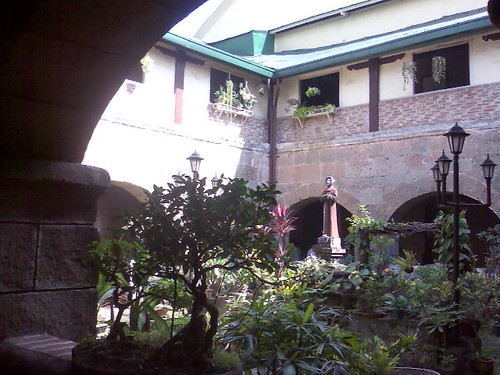
- The Franciscan Garden
Just when you thought that Quezon City has nothing to offer but the metro feel, top schools, colossal malls and trendy subdivisions, think again.
When you reflect on the old Filipinas what comes to mind is Manila and the well-known provincia's (Vigan, Taal etc) but rarely someone would think of Quezon City as having something similar to the grand old churches and casa's of this enchanted Filipino Spanish towns.
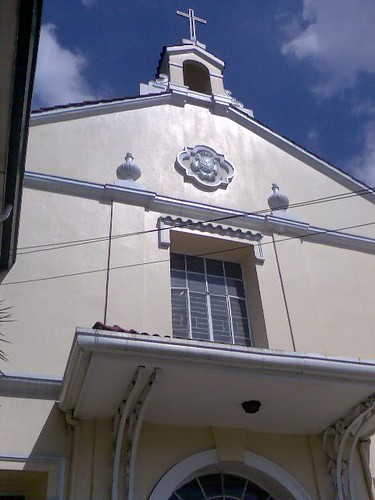
- The new fascade of the ol' Iglesia (it still stands on the original foundations of the first church, the rearrangement and renovations has drastically altered the first church)
Well, of course there are fine historical sites in Quezon City, I've always wanted to visit President Quezon's final resting place in Quezon circle but never had the time (or find not to have time). In Bagong Silang you have the site of the "Battle of San Mateo", Pugad Lawin and the Tandang Sora Shrine, just to name a few.
But the most amazing discovery I made recently was the Franciscan church in San Francisco del Monte, and it was a wonderful discovery. For hundreds of years it has served its dominion, not only establishing Christianity, which it has successfully completed but also introduce arts, like music. The town organizer and church builder, San Juan was a gifted musician.
Driving from Manila via España to Quezon City most of the times is a taxing charge(especially if your from the south metro), passing through this major roads are always better during the weekends. I thought for awhile that Sr.Gomez would take us to Santo Domingo, the church that was originally built in Manila but was later relocated because of its demolition during the American's unrelenting offensive of Manila (Liberation?). The La Naval de Manila (in Quezon City?) culture lost its continuity - but there must be some divine explanation we don't know that would explain why, the old site I believe is where BPI now stand in Intramuros.
Going back to this goldmine of a discovery, we headed to the San Francisco del Monte Church and was welcomed by its historical markers, appraising it made me appreciate that I was in one of the oldest church in this once Spanish province, here, in the heart of the metropolis.
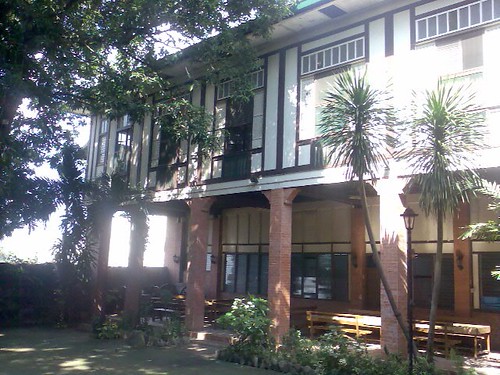
- The Antillan
Pedro Bautista Blasquez arrived in 1584 with the 4th group of Franciscan Missionaries to the Philippines, was not an inexperienced man. He was 42 years old who acquired fame as a preacher in the cathedral of Toledo, Spain. He taught philosophy for three years in Madrid and was an excellent musician. He arrived as the head of the mission and was to preside as the chapter of custody. In a word he was a mature man, educated, experienced and placed in a position of authority.
The fourth Chapter of Custody and the first after the arrival of Pedro Baustista was held in the convent of Manila on September 24, 1584. The conference elected Pedro Bautista, Custos of Superiors of all Franciscans in the Philippines.
Apparently he preferred not to accept the position of authority. After the election Fray Pedro hid and only later when his brethren refused to accept his resignation did he took the position. That was in 1588. having accepted the responsibility he put himself dynamically into his work. He animated his religious to live out their profession and to care the conversion of others. To encourage them he learnt the language of the natives. He counseled his Friars living at a distance and encouraged them with his letters worthy of a holy man.
Because of his deep concern for the spiritual welfare of his friars, Pedro Bautista saw the need for a secluded place where the missionaries, true to reform spirit of their province, could revive their spiritual vigor by prayer, reflection and discipline. After a long search, he selected a site a little over a league from Manila.
On February 15, 1590 Gov. Santiago De Vera donated "Una Pequeña Encomienda", an estate of some 150 hectares to the Franciscans: Pedro Bautista immediately ordered the construction of a small bamboo and nipa convent and church under the title of Nuestra Señora de Montecelli, which however, was popularly known from the very beginnings of "San Francisco Del Monte".
It was opened as a retreat for missionaries and as a novitiate house from 1580 the novitiate had been in San Francisco De Manila but the noise of the city and the coming and going of the friars to the Provincia headquarters made it less than appropriate for contemplation. The first profession recorded in San Francisco Del Monte took place in December of 1591.
- The cave for prayers (yes, this guys are pretty serious with their prayers that they dug a cave where they can pray in complete silence)
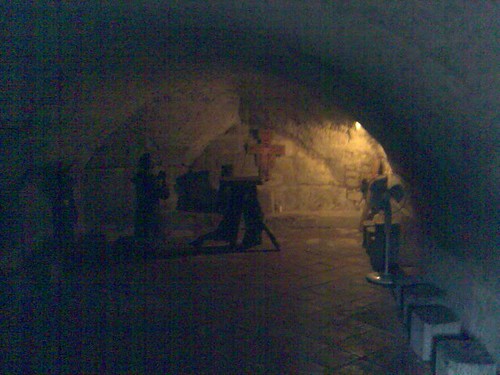
In 1699, a church was made of stone was built and the convent restructured. This was dedicated t the newly beatified Blessed Pedro Bautista and his companion martyrs. This church had now become the sanctuary with the Baroque altar that is still preserved today.
In 1895, the friars abandoned the lace and Filipino revolutionary forces occupied the church. In 1898, American Negro soldiers of the occupued the church. the church was left idle until it was repaired in 1912. In 1914, the Church was blessed and a town fiesta was held in honor of San Pedro Bautista.
On November 11, 1932, the Church was declared a parish name in honor of its founder and patron saint, San Pedro Bautista, before the decree, the parish belonged to the parish of Caloocan.
In 1989, the three century old baroque altar was transferred to the main sanctuary. In 1990, a statue of San Pedro Bautista was enshrined at the center of the altar. One February 5, 1997, the parish marked the 400th anniversary f the Martyrdom of San Pedro Bautista. On February 25, 2007 the parish church was declared an archdiocesan shrine to be known as Sanctuario de San Pedro Bautista in view of its monasterical and religious significance.
After a successful effort from Padre Gobo left for Manila but he was lost at sea. Gov. Dasmariñnas waited one futile year for his return then decided to send Pedro bautista as his new ambassador. brother Gonzalo Garcia who knew Japanese very well was designated as the new emissary's interpreter; tow other completed the group. after his diplomatic mission Pedro Bautista was to stay on as the permanent representative of the Governor of Manila and labor for the conversion of the Japanese.
That was the plan of the Governor but the "Superior of the Jesuits in Manila" reminded him of the prohibition of Gregory XIII. The Governor called a meeting at the church of San Agustin on May 18, 1593 to discuss with the prominent theologian and authorities what could be done. The outcome was his firm decision to send Bautista's party.
On May 30, 1593 Pedro Bautista and his companions sailed for Japan, their new work and eventually their martyrdom four years later.
Continuing the policy of his famous predecessor Fray Juan de Placentia, "The Father of Reductions", San Pedro worked to gather the native of the towns. In Morong, he obliged the numerous rancherias spread throughout the mountains to form the "Doctrinea" of Morong. He was the moving spirit behind the behind the foundation of many towns. In Camarines: Quipayo, Cagsawa, Baac, Oas, Libmanan and Buhi. In Laguna - Rizal area: Tanay, Baras, Longos and Paquil. And in Bulacan: Catangala (Polo). He likewise started churches and convents of Meycuayan and Calilay, centers in the days of Bulacan and Tayabas.
It was a great experience walking around, seeing people celebrate mass on a Sunday, thinking that Catholic tradition here is almost as old as the founding of the walled city, it was alive, surviving the wars (both sectarian and military conflicts). The place is a legacy of the Catholic missionaries. It reminded me how it all happened, the religion and the country.
One of the most interesting historical facts that were not taught in schools is that this Catholic missions, founded almost all of our old towns, paving the way to unanimity, inspiring the shape of the islands into what we know now as the Philippine Islands, christianization and domination, and perhaps its unseen and under valued gift, our identity.
As I was walking along the Franciscan garden I tried to visualize what it was like living their lives, far away from their beautiful mother country, the endless prayers and the remote, often, perilous missions to convert, some say we never desired their interference and Christian convertion but we still remain transformed Katoliko's anyway, to say now that 'all Friars' - are wicked and that they corrupted us, is plainly erroneous.
Let's give credit, where credit is due
...speaking of credits, this two brought me here.
...speaking of credits, this two brought me here.
Gracias, mis amigos...
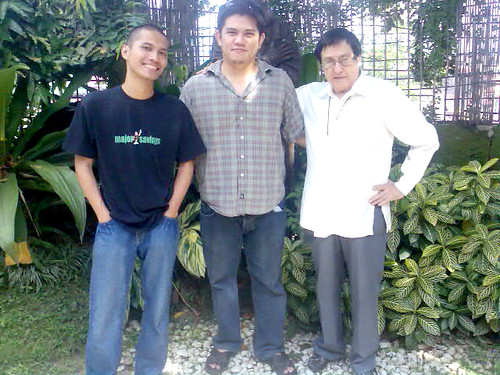
- Pepito, me & the man, the legend GGR
Wednesday, October 22, 2008
La Gira, part I
In what could be a first in a series of historical pilgrimages, we were toured around Binondo and Sn. Nicolas Manila by the great Filipino artist-historian, future artista nacional, Señor Gomez Rivera. With his astonishing grasp and familiarity of the locale, he took this two (Pepito y yo) tyro chroniclers into the begrimed esquinitas of Binondo and the crumbly old Spanish era houses of Sn. Nicolas, telling tales and legends of what was once the beautiful arrabales of old Spanish Manila.
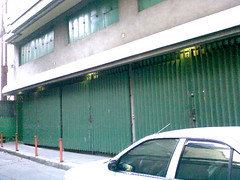
One street, concealed, dark and filthy, was where the house of Pepe Rizal's relatives once stood, no marker just some new shops selling stuff (the products you see labeled in Mandarin) and a horde of beggars asking for some change. Here was Don Francisco Mercado final stop before joining his popular hero son in the afterlife. He died in this place, he lived a silentious life, he was the typical Chinese Filipino, he was frugal, cautious always and was a devoted family man. It was (the Mercado residence), according to Señor Gomez, a small house compared to the other rich casa's "pero elegante", and so is the streets where this casas stood. Now, this gutterless, cramped street - this part of Calle Estraude is but a shadow of what was once an alluring little mestizaje neighbourhood with a living small estero for a view (now, I think if ever you fall in that estero you'll die, not from drowning but because of its mephitic water!).
[caption id="" align="alignnone" width="240" caption="Calle Estraude (Don Francisco's house once stood here)"]
 [/caption]
This awful looking buildings are testament of what can be referred to as the districts progressive transformation, from the old Binondo town to the new town (literally ‘new' because the old houses are being phased out!). Economics often times dictate what would become of a locality, its future is always tied to its commerce. A rustic Macati then is a financial city now, with all its skyscrappers hoovering up above, a farm, a hill could become a residential villa. At this rate (accelerating phase as can be observe this past decades), we are losing more and more of this heritage sites. Once we lost them, we lost them forever - this we have to remember. Is this really progress?
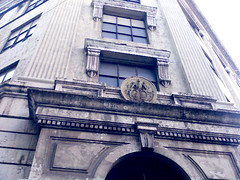
Another building left to decay is the celebrated Hogar Filipino. This hotel was the loftiest structure in the 30's, arguably the finest concrete building created by its generation, in that legendary street called Anloague. The wedding gift (yes, it was for a Zobel daughter) hosted foreign dignitaries and notable personage. It was spacious, elegant and yes, a very expensive place to spend the night in! but like many structures after the war, it was neglected. Prestige drifted away from this part of the town (partly due to poor city management & planning) so in this once graceful belt, whose edge tips the river Pasig, whose fresh water joins the sea, died, not too long ago. It can be revived - how? this is the challenge for this new Manileño generation.
[caption id="" align="alignnone" width="240" caption="Hogar Filipino"]
 [/caption]
And the list goes on.
As we were driving around Binondo, we came into a screeching halt, I thougth that we ended up in a jeep terminal, then my passengers reminded me that Luna St. usually are like this. So you'll just have to drive around the jam. Good thing was its Sunday, so taking direction from Señor Gomez, circling some esquinitas, with some twist and turn he brought us to Urbiztondo, the Antonio Luna birthplace.
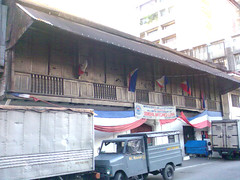
Unlike the sad fate of that Estraude home of the Rizal's, The tagailog's place of birth was intact. Thank God. Its fronting the institution named after that prehispanic hero Rajah Solaiman. The abode's fascade at least is preserved with some marks of decay, it was decorated by some banners and small flags commemorating its famous son Antonio's birthday. Since no one can go in, one could only wonder what's inside. It was an elegant, noble house, one thing that you can say about this old casas of Binondo and San Nicolas is that, although their confined in space due to the population of the district (compared to the bahay na bato in the countryside), they never forgot about style, they were western in their sophistication and taste! architecture was detailed from the wide windows, classy iron grills, chic doors, genteel roof - Ah, I think they heard William Morris, that British Socialist and Poet (1834-1896), when he said "have nothing in your house that you do not know to be useful, or believe to be useful".
[caption id="" align="alignnone" width="240" caption="Luna Residence"]
 [/caption]
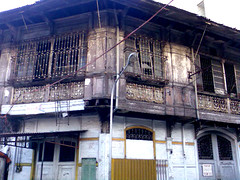
Exiting Urbiztondo heading straight towards San Nicolas all of the old casa are lined up. like pretty maids all in a row -- the Sunico house, built on Calle Barcelona corner Jabonero, is now deserted but a closer look would show how this propertied families built their houses. From its wide windows, one could see all the way to Intramuros. Down to the very last piece in this disintegrating houses is art. Right across the Sunico's, another old house went down. (Nalungkot talaga ako), it broke my heart seeing something so beautiful destroyed. Some excavation was taking place already, looks like a high rise project - century old adobe bricks and lumber being scrapped. We all look and felt funereal, standing there and seeing those people hammer away, are they even aware what their doing? In this town, its just another old house, but for Manila another piece of history ditched.
[caption id="" align="alignnone" width="240" caption="Sunico house"]
 [/caption]
The Casa Vizantina (I already featured this here), arguably the grandest of all the San Nicolas houses, three storey high extended for almost a block. It currently it holds a sizeable squatting community inside. Now, considered a dangerous structure, it was once a hotel and an institute (Instituto Manila, now UM). This marvel of Filipino architecture is headed to the slaughterhouse, there are already plans to tear it down. Same story here.
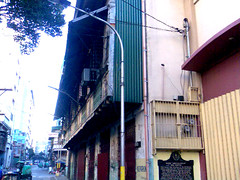
The Pio Valenzuela house was next, thank God it has a marker, I hope no ones pissing on it becaue its placed in a corner and its just a feet from the ground. The NHI marker was Installed commemorating what was the house of a hero and the site where the revolutionary paper, "Kalayaan" was printed. Pio figured popularly in the life of Rizal and the revolution for it was him who announced that the national hero denouced the revolution, much to the dismay of Boni, he did however, had another version after the war ended, this time he claims that the Calambeño was supporting the movement.
[caption id="" align="alignnone" width="240" caption="Pio Valenzuela's residence where the Kalayaan was printed"]
 [/caption]
[caption id="" align="alignnone" width="240" caption="Rogelio de la Rosa once was here!"]
 [/caption]
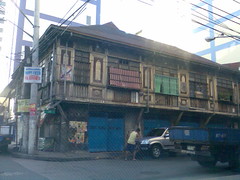
Just before we head out we dropped by what was once Rogelio de la Rosa's house, the matinee idol live in San Nicolas with his wife Lolita Bayot. He raised his son, Rogelio II in that old house in Calle Lara. The Señor claims that Rogelio was not proficient in Castillian and that his lines are often dubbed. This Kababayan of the Macapagals would become a senador under the Partido Liberal. He could be considered the Father of Showbiz turned politicos, his bid for the presidency was not successful. He was assaigned ambassador to various countries.
Every inch of Binondo and San Nicolas has a story to tell, Some streets are no more (a Calle Nueva is now renamed Yuchengco), old houses are slowly diminishing (this year we witnessed several houses taken down) - their like those endangered animals, if not conserved, without planning and vision, they would become extinct. "There was once a house there..." - the Señor would tell us, this line would soon become ours, as we tell the sad fate of this houses.
Wednesday, September 17, 2008
The Cross of Tunasan San Pedro
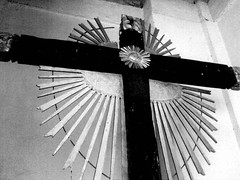
[caption id="" align="alignnone" width="302" caption="San Pedro's Cross of salvation"]
 [/caption]
The ‘Cross of Tunasan San Pedro' has been with the old town of San Pedro for centuries. Its miraculous healing powers became popular during the epidemic years, were countless of towns folk sought divine healing from the deadly diseases that ravaged the once rustic town.
It's a silent witness to the transformation of the small town from a Sampaguita plantation and a narrow passage to the richer Laguna towns to what it is now, a residential and industrial urban municipality. It survived both natural and man made disasters - during this difficult years the older generation of San Pedro knelt in front of the miraculous cross and prayed for a better tomorrow.
Legends varies, from its sudden apparition from some unknown San Pedro barrio to its creation by some miracle Abbott, some even claims that it came straight from heaven. Its one of those icons that represented time and people, one could not tell a story about the small town without suggesting to see it for a visit to San Pedro Tunasan during the old days is incomplete without touching its base.
Today, its odd that its not as revered as it was once, one could watch people go in and out of the church without even noticing the mighty Cross, the Krus ng San Pedro Tunasan. Once it attracted hundreds of churchgoers from different places in La Laguna during Sunday's and dates of Catholic religious importance. Now, it sits quite in its dark place, with out lights, without candles and if you were to sit inside and attend mass, your back would face it. How could such an important relic be relegated to an obnoxious space inside the church that it practically created?
Rizal appreciated its role both as spiritual and cultural representation of the people of Tunasan San Pedro, he mentioned the cross in his first novel together with the other celebrated Catholic images of the old Spanish era .The least that we can do is its restoration as the center piece of the church, it deserves no less.
A closer look would reveal that its base is of poor construction; a piece of rock holds it in place. Some genius mind painted over the original varnish. Obviously the preservation and its location in the church was not one of those well thought out plan. It could be attributed to a miracle that this Cross made of wood and is said to be the oldest Catholic cross in the whole of Laguna is still in a very good condition.
Perhaps, the reason why its not being noticed is that, today - church and government officials failed to highlight not only its place inside the iglesia but its role as San Pedro's greatest religious icon.
There is no IKON in this small struggling town that could better represent its past than this cross! La cruz de Tunasan San Pedro!
Saturday, September 13, 2008
Response to the post "Filipinos Are Not Hispanic"
I stumbled upon this post by FIl-American Jon Torres over the popular site Associated Content. I would like to share my response to all my reader to some of his well intentioned subjects regarding his reaction as a Filipino to 'being referred to as Hispanic', something that is a common experience for those Filipinos who lives close to big Latino communities in the US. (All the italics are mine)
Filipinos Are Not Hispanic
A Few FAQ's I Keep Having to Answer
By Jon Torres, published Mar 21, 2007
Yesterday I was making a remark to my friend about my Asian heritage and he replied, "Asian? But I thought you were Filipino!" I could only laugh (politely, of course) at his statement, not only because it sounded wrong, but also because I had heard it once too often. This cannot be dismissed away with some flippant remark I'm tempted to make, like "Don't you ever wonder why there's no Filipino food at Taco Bell? "
---
*This is quite common in the States, Filipinos - are being recognized as Hispanics, mainly because of the last name, facial feature & religion but Filipinos historically are Hispanics. Our Hispano culture makes us Hispanics. Mistake is made when hispanization is equated with blood relation and geography.
---
There seems to be an all-too prevalent belief among the many westerners I meet, which is the notion that Filipinos are Hispanic. While I can see (more or less) how this could be reasoned in a roundabout way, and make its own odd sense, it is nonetheless wrong. To someone who has grown up in the Philippines, it does sound plausible from a certain point of view, yet still very strange for a number of reasons. I will address some questions I frequently get asked on this apparently novel piece of information.
Where is the Philippines? According to Wikipedia ( as well as every single one of my social studies teachers) the Philippines is in Southeast Asia. At this point, I rather think this should end any further explanation. We are much, much closer to Taiwan, China, Japan, Indonesia and Singapore than any country in Europe or Latin America. The geographical neighborhood alone should clue you in to the probable ethnicity of the Filipinos. Perhaps it is simply this lack of awareness as to where the Philippines actually is, that causes many people to guess and consequently, make mistaken assumptions based on that.
___
Our location makes us Asian, but this does not undue our Hispanic roots for the simple reason that hispanization refers to history, language and culture. So if I were to answer the question "if Equatorial Guinea (an African nation) is a Hispanic nation?" my answer would be yes, not only because they speak Castilian but also because hispanization has taken root in their culture and society. Their geography, being a small state in the middle of the African wouldn't nullify their identity. Same with ours and some of the pacific islands that were under Spain then.
If one is to travel to China, Japan or Thailand - a Filipino would almost immediately feel like in a different world, an alien, "Asia was never at home with us", Nick Joaquin said and this is true, Manila is a city with little similarity with cities like Bangkok, Beijing and Tokyo etc etc - theirs is an oriental culture, ours is of Hispano origin. On the other hand, if you were to visit Mexico and all the other Latino countries - you would be awed how strikingly similar our culture is with them. So don't be surprised if American's see them in you.
___
How do you explain the 80% Catholicism, which is obviously from Spanish colonization of the Philippines? This is true. We were converted from mostly earth-based, ancestral worshipping spiritual beliefs, and baptized as Catholics in the 16th century. This was instrumental in Spain's control over the Philippines for over three centuries as colonial property, by using organized religion along with political manipulation (without separation of Church and State). This had the effect of having Filipinos subservient to Spanish rule, without enjoying the benefits of being citizens. In short, we were the property of Spain, but we were not Spanish citizens.
___
Part of the reason why Americans looks at Filipinos as Hispanic is because of our religion. Most Asians are seen as Orientals in the US, Orientals for them practices Buddhism, Hindu or religions they see as unfamiliar and mystical. Since Filipinos are Asians in their mind, they would be surprised to see Filipinos practicing the religion of the immigrant Latinos.
Since hispanization is the process by which a place or a person absorbs characteristics of Hispanic society and culture. We are Hispanos more than asianos. Unfortunately, most are not aware of this fact.
"Property of Spain?" - I think this author never heard about the Cadiz constitution - anyway we were all subjects, under a monarchy that translates to citizenship. This is the reason why Filipinos with means then were able to study, live and travel abroad, they were Spanish by right. Could you imagine the Ilustrados, founding a liberal paper called La Solidaridad in the heart of Spain? If they were not protected by their right as Spanish citizens they could've been easily executed. In the days of the Yankees, anyone who stood up here and oppose them was blasted into oblivion, they only ceded leadership after they've been able to guarantee that they would still be in control, in terms of economic policies and the nations resources.
In the American years, it would be good to review that we never became citizens under their commonwealth, they never wanted us even with the noisy clamor of the federalistas. I'm sure all Filipino immigrants know that it is not an easy process to go there and work - this is how we were repaid. Our glorious stand with the Americans during WWII and all the service we render under their flag is all but forgotten now. While The Japanese and Germans, on the other hand, who fought against them, today, can freely travel in the US without being bothered by the process we usually face. Talk about history and how it is easily forgotten by this western power.
___
But don't Filipinos speak Spanish? I get this question several times a year, almost on a monthly basis, and every time I want to say a resounding "No!", they point out my own particular situation, because I happen to speak it passably well. In my case, as I believe is the same with many Filipinos living in the United States, I learned it here: both from Mexican friends and the local community college. The truth is, most Filipinos do not speak Spanish at all. Almost none of us do. From the 19th century American occupation, English has long replaced Spanish as the western lingua franca of the country, and has been for a hundred years.
___
We used to speak Castillan as a nation, but when the American's came it slowly eroded but it is, as it was pointed out the 'lingua franca' back in the days. The American system then recognized literacy based on the use of the English language. Regardless whether you speak or write in Tagala or Castilian you would still be tagged as illiterate if you would neglect the use and study of this foreign language and since there is no way for someone to progress in the new American standard of education if one would not take up English, everyone had no choice but to learn it.
___
It certainly doesn't help that Filipinos are generally adaptable, and being from a country with over a thousand local dialects, will be averse (or too polite!) to saying they do not understand, or are unable to learn a certain language. We eventually pick up enough of the local language to get by. True, our main dialect, like many others, is in fact peppered with Spanish words, making it fairly easy for us to learn Spanish if we tried. But what few Spanish words that we use in our daily colloquial speech are mostly pidginized and remarkably different from their original meanings (Get this: "leche" is a mild curse word in Tagalog!). Also, we have much more of the neighboring language groups in our vernacular: mostly Malaysian, Chinese, Arabic, and more recently, plenty of English.
___
It seems that the author of this failed to research on how many Spanish words there are in what most scholar's claims as 'pure' tagala. Aside from thousands of Castilian words in the recognized national language, a study of the Spanish language would also highlight that some of the common words we use that we thought were ours were from the Castilian language. Adapted to suit local pronunciation.
I don't even want to describe what "leche" means as a curse. :)
___
Why do you have a Spanish last name? Doesn't that mean you have at least one Spanish bloodline? A Spanish surname is very common among Filipinos, and this understandably can lead to confusion. It's like meeting a Japanese person named Park, or more commonly, a Caucasian person named Lee. It however, does not reveal a person's ancestry automatically. In the case of most Filipinos, the mass-conversion also led to our being relabeled with 'Christian' surnames. Genuine intermarrying was probably quite rare back then. I can confidently say that I am no more Hispanic than your roll of "Scotch" tape has been anywhere near Glasgow.
___
Your last name has nothing to do with your identity. You could be Chinese and possess a name like Juan de la Cruz but you would still be Chinese when you wake up in the morning not unless you got that name from the history and culture of your people - only then that it would mean something. Ancestry and places of origin does not define an identity. Again, there is confusion in the definition of nationality, location, ancestry and identity.
It was not just "relabeling" - it was in effect, creating identity for the natives the aside from of course the benefits it would provide the Government then.
They say, your name says a lot of things about you, this is true, a Hispanized name tells the history of adapting to the Spanish ideals of society then, as it was enforced by Claveria, the fact that it was accepted (voluntarily or involuntarily) means our ancestors assimilated into a Hispanic society.
These are 'Christian' names as he pointed out goes back to the process of hispanization. The one thing that the author failed to study is the process of becoming a "Filipino" . The review of this would bring one closer to our real identity. The author already mentioned the Catholic religion earlier, that's Filipino identity along with the culture and heritage.
Some backward thinking folks would elect to go back to the old tribes for which I'd rather not, what we have, we should keep and respect.
___
So I hope it no longer seems to you a bold statement to say that Filipinos are not Hispanic, not from Latin America, do not speak Spanish nor are even of mostly Spanish ancestry. I encourage you to look up even more information on sites such as Wikipedia, and if possible, find some Filipino friends and raise a discussion, which I have no doubt will be a lively one. And have share some Filipino food while you're talking. We like to think it's better than Taco Bell, anyway.
___
I think everyone would be in agreement that our dish is the best in the world!
By the way, thanks to Jon for improving my calligraphy. I happen to take interest in this old art, his on line videos were awesome.
Friday, September 12, 2008
THE BLACK LEGEND ON THE STATE OF EDUCATION
THE BLACK LEGEND ON THE STATE OF EDUCATION
By Pio Andrade
Filipinos in the 20th Century were repeatedly taught or told in schools and in the press, that Spain always kept their ancestors uneducated to have them ignorant and the always docile subjects of Spain. The blame was, in particular, thrown upon the friars, "who, from motives of their own, discouraged the learning of Spanish by the natives, in order that they may always act as intermediaries between the people and the civil authorities, and thus, retain their influences over their charges". The most common proof cited for the alleged uneducatedness and ignorance supposedly reigning in Hispanic Philippines is the incontrovertible fact that only the Philippines, among all the other former Spanish colonies, is not Spanish-speaking today. But was this really so?
The 1896 revolution, the first revolution in Asia by a colonized people for independence from the colonizer, refutes the charge that Spain did not educate the Filipinos, for revolutions are not made by the ignoramuses but by the educated folks. Indeed, most of the leading lights and leaders of the 1896 Revolution were Ilustrados, or educated folks. The propaganda literature and the communications coming from the Revolutionaries were mostly in Spanish; and, the Malolos Constitution was debated and drafted in Spanish. The revolution was made possible by the widespread knowledge of Spanish. Thus, Spanish was the language of the 1896 Revolution and Philippine nationhood.
King Philip II's Law of the Indies (Leyes de Indias) mandated Spanish authorities in the Philippines to educate the natives, to teach them how to read and write and to learn Spanish. However, the latter objective was well-nigh impossible given the realities of the time. First, there were very few Spaniards in the Archipelago to teach Spanish at that time. Second, the Philippines, at the coming of Spain was inhabited by diverse tribes with different languages, customs, and religion. Third, the geographical barriers - - - the seas, the mountain ranges, lush virgin forest and the absence of enough roads made travel and communication difficult during those years. Thus, the friars, the vanguard of evangelization and education, opted instead to learn the native languages first and in order to use them as tools to evangelize and teach the natives in the missionary schools.
But Spanish was also taught to those who wished to learn the language. Among these were the native principalía and the Chinese traders who only began to come in greater numbers after the coming of Spain to the Philippines.
Another proof that Spain's language education was taking place in the first years of Hispanization in this Country was the Galleon Trade. The Galleon Trade would not have been possible if the Filipinos, Spaniards and Chinese could not communicate with each other in Spanish.
In 1863, with the passage of the Education Reform Act in the Spanish Cortes, the Philippine public school system was born. Separate schools for boys and girls were established in every pueblo for the compulsory education of Filipino children. The law also established the Escuela Normal to train male and female teachers. This was ten years before Japan had a compulsory form of education and forty years before the American government started a so-called public school system in the country.
One of the most vociferous voices claiming that Spain did not educate the Filipinos was UP historian emeritus Teodoro Agoncillo who wrote in THE REVOLT OF THE MASSES that "When the Americans took over the Philippines, only 2.5% of the Filipinos spoke and wrote in Spanish". This figure was taken from the 1880 book of Cavada Mendez de Vigo. Later, in his history textbook , THE HISTORY OF THE FILIPINO PEOPLE, Agoncillo also claimed that "it is safe to say that the literacy rate of the native population was somewhere between 5% and 8%". These Agoncillo claims are wrong for these two statements on the Philippine literacy can not be sustained by factual evidence.
Agoncillo failed to see that since 1811 with the publication of DEL SUPERIOR GOBIERNO, the Philippines had a popular press which further disseminated the Spanish language in the country. The Philippines was the first country in Asia to have a popular press in Spanish and, by the coming of Dewey, there were many more popular newspapers and books published in Spanish. The several newspapers in the native languages most always carried Spanish language sections. Manila, itself, (then with about half a million people) had three Spanish language dailies in the morning and three other dailies, also in Spanish, in the afternoon. These dailies in Spanish had no equal counterparts in other Oriental countries.
Another factor for increased Spanish literacy was the Chinese population. The Chinese community obligates Chinese cabecillas or Chinese barangay captains to teach rudimentary Spanish to new Chinese immigrants. After a month in these Chinese-owned schools, the Chinese immigrants spoke kastilang tindahan, or Caló Chino Español, a kind of Spanish Chabacano, that later become fluent albeit accented Spanish . When these Chinese immigrants intermarried, they brought forth Spanish-speaking mestizos. The 100,000 Chinese population at the turn of the century were all conversant in Spanish though in varying proficiency, from the kastilang tindahan of the new Chinese immigrants to the fluent Spanish of Chinese old timers.
Actually, Spanish grew even more during the 1900-1920 period. Professor Henry Jones Ford of Princeton University in his 1913 secret report on his six months travel and research about the Philippine situation to President Woodrow Wilson, had this to say on the use of Spanish in the country at that time: "There is however, another aspect of the case that should be considered. I had this forcibly presented to me as I traveled through the Islands, using the ordinary conveyances and mixing with all sorts and conditions of people. Although on the basis of School statistics the statement is made that more Filipinos now speak English than any other language, no one would think of the testimony of one's own ears. Everywhere Spanish is the speech of business and social intercourse. For one to receive prompt attention, Spanish is always more useful than English and outside of Manila, is almost indispensable. Americans travelling about the Islands, use it habitually. What is more, they discourage the use of English. This was a development that took me by surprise. I asked an American I met on an inter-island steamboat why he always spoke Spanish to the stewards and waiters, and whether they could not understand him in English. He said that probably many of them could but one would not be treated with as much respect using English and not Spanish; that Filipinos seem to loose their manners using English, becoming rude, familiar and insolent."
Professor Ford further underscored the widespread use of Spanish in the country by writing about the existing press thus: "There is unmistakable significance in the fact that there is not in all the Islands one Filipino newspaper published in English. All of the many native newspaper are published in Spanish and in the dialect.
It is relevant to mention here that as late as 1930, the Spanish dailies had a much bigger circulation than either Tagalog or English dailies. Noteworthy also is the fact that in the 1930's there were a few Chinese periodicals in both Chinese and Spanish.
Modesto Reyes Lim in a 1924 issue of the Rizalian Magazine ISAGANI vehemently criticized the imposition of English upon the Filipinos. He wrote: "¿No es acaso de sentido común, que hubiera sido muy fácil propagar más el castellano, que ya se usaba como lengua oficial y se hablada ya por muchísimas familias filipinas dentro y fuera de sus hogares, y del cual contaba entonces el país con muchos literatos, poetas y escritores distinguidos?" (Is it not of plain common sense to know that it would have been far easier to further propagate Spanish, which was already the official language and the mother tongue of so many pure Filipino families, in and out of their homes, and from whom where born so many writers, poets and distinguished men of letters?)
"Indudablemente, como dice un ilustre filipno miembro actual prominente de la administración de justicia, que con el mismo tiempo y dinero gastado, sistema y otros medios modernos de instrucción empleados en la enseña del inglés, si en lugar de éste se hubiera propagado en mucha mayor proporción que se haya hoy propagado el inglés."
(There is absolutely no doubt, says a Filipino jurist of today, that if the same time and money, and the same teaching system and methods, now employed in the teaching of English were instead dedicated to the teaching of Spanish, the latter would have been propagated in a much larger proportion in which English has been propagated.)
By Pio Andrade
Filipinos in the 20th Century were repeatedly taught or told in schools and in the press, that Spain always kept their ancestors uneducated to have them ignorant and the always docile subjects of Spain. The blame was, in particular, thrown upon the friars, "who, from motives of their own, discouraged the learning of Spanish by the natives, in order that they may always act as intermediaries between the people and the civil authorities, and thus, retain their influences over their charges". The most common proof cited for the alleged uneducatedness and ignorance supposedly reigning in Hispanic Philippines is the incontrovertible fact that only the Philippines, among all the other former Spanish colonies, is not Spanish-speaking today. But was this really so?
The 1896 revolution, the first revolution in Asia by a colonized people for independence from the colonizer, refutes the charge that Spain did not educate the Filipinos, for revolutions are not made by the ignoramuses but by the educated folks. Indeed, most of the leading lights and leaders of the 1896 Revolution were Ilustrados, or educated folks. The propaganda literature and the communications coming from the Revolutionaries were mostly in Spanish; and, the Malolos Constitution was debated and drafted in Spanish. The revolution was made possible by the widespread knowledge of Spanish. Thus, Spanish was the language of the 1896 Revolution and Philippine nationhood.
King Philip II's Law of the Indies (Leyes de Indias) mandated Spanish authorities in the Philippines to educate the natives, to teach them how to read and write and to learn Spanish. However, the latter objective was well-nigh impossible given the realities of the time. First, there were very few Spaniards in the Archipelago to teach Spanish at that time. Second, the Philippines, at the coming of Spain was inhabited by diverse tribes with different languages, customs, and religion. Third, the geographical barriers - - - the seas, the mountain ranges, lush virgin forest and the absence of enough roads made travel and communication difficult during those years. Thus, the friars, the vanguard of evangelization and education, opted instead to learn the native languages first and in order to use them as tools to evangelize and teach the natives in the missionary schools.
But Spanish was also taught to those who wished to learn the language. Among these were the native principalía and the Chinese traders who only began to come in greater numbers after the coming of Spain to the Philippines.
Another proof that Spain's language education was taking place in the first years of Hispanization in this Country was the Galleon Trade. The Galleon Trade would not have been possible if the Filipinos, Spaniards and Chinese could not communicate with each other in Spanish.
In 1863, with the passage of the Education Reform Act in the Spanish Cortes, the Philippine public school system was born. Separate schools for boys and girls were established in every pueblo for the compulsory education of Filipino children. The law also established the Escuela Normal to train male and female teachers. This was ten years before Japan had a compulsory form of education and forty years before the American government started a so-called public school system in the country.
One of the most vociferous voices claiming that Spain did not educate the Filipinos was UP historian emeritus Teodoro Agoncillo who wrote in THE REVOLT OF THE MASSES that "When the Americans took over the Philippines, only 2.5% of the Filipinos spoke and wrote in Spanish". This figure was taken from the 1880 book of Cavada Mendez de Vigo. Later, in his history textbook , THE HISTORY OF THE FILIPINO PEOPLE, Agoncillo also claimed that "it is safe to say that the literacy rate of the native population was somewhere between 5% and 8%". These Agoncillo claims are wrong for these two statements on the Philippine literacy can not be sustained by factual evidence.
Agoncillo failed to see that since 1811 with the publication of DEL SUPERIOR GOBIERNO, the Philippines had a popular press which further disseminated the Spanish language in the country. The Philippines was the first country in Asia to have a popular press in Spanish and, by the coming of Dewey, there were many more popular newspapers and books published in Spanish. The several newspapers in the native languages most always carried Spanish language sections. Manila, itself, (then with about half a million people) had three Spanish language dailies in the morning and three other dailies, also in Spanish, in the afternoon. These dailies in Spanish had no equal counterparts in other Oriental countries.
Another factor for increased Spanish literacy was the Chinese population. The Chinese community obligates Chinese cabecillas or Chinese barangay captains to teach rudimentary Spanish to new Chinese immigrants. After a month in these Chinese-owned schools, the Chinese immigrants spoke kastilang tindahan, or Caló Chino Español, a kind of Spanish Chabacano, that later become fluent albeit accented Spanish . When these Chinese immigrants intermarried, they brought forth Spanish-speaking mestizos. The 100,000 Chinese population at the turn of the century were all conversant in Spanish though in varying proficiency, from the kastilang tindahan of the new Chinese immigrants to the fluent Spanish of Chinese old timers.
Actually, Spanish grew even more during the 1900-1920 period. Professor Henry Jones Ford of Princeton University in his 1913 secret report on his six months travel and research about the Philippine situation to President Woodrow Wilson, had this to say on the use of Spanish in the country at that time: "There is however, another aspect of the case that should be considered. I had this forcibly presented to me as I traveled through the Islands, using the ordinary conveyances and mixing with all sorts and conditions of people. Although on the basis of School statistics the statement is made that more Filipinos now speak English than any other language, no one would think of the testimony of one's own ears. Everywhere Spanish is the speech of business and social intercourse. For one to receive prompt attention, Spanish is always more useful than English and outside of Manila, is almost indispensable. Americans travelling about the Islands, use it habitually. What is more, they discourage the use of English. This was a development that took me by surprise. I asked an American I met on an inter-island steamboat why he always spoke Spanish to the stewards and waiters, and whether they could not understand him in English. He said that probably many of them could but one would not be treated with as much respect using English and not Spanish; that Filipinos seem to loose their manners using English, becoming rude, familiar and insolent."
Professor Ford further underscored the widespread use of Spanish in the country by writing about the existing press thus: "There is unmistakable significance in the fact that there is not in all the Islands one Filipino newspaper published in English. All of the many native newspaper are published in Spanish and in the dialect.
It is relevant to mention here that as late as 1930, the Spanish dailies had a much bigger circulation than either Tagalog or English dailies. Noteworthy also is the fact that in the 1930's there were a few Chinese periodicals in both Chinese and Spanish.
Modesto Reyes Lim in a 1924 issue of the Rizalian Magazine ISAGANI vehemently criticized the imposition of English upon the Filipinos. He wrote: "¿No es acaso de sentido común, que hubiera sido muy fácil propagar más el castellano, que ya se usaba como lengua oficial y se hablada ya por muchísimas familias filipinas dentro y fuera de sus hogares, y del cual contaba entonces el país con muchos literatos, poetas y escritores distinguidos?" (Is it not of plain common sense to know that it would have been far easier to further propagate Spanish, which was already the official language and the mother tongue of so many pure Filipino families, in and out of their homes, and from whom where born so many writers, poets and distinguished men of letters?)
"Indudablemente, como dice un ilustre filipno miembro actual prominente de la administración de justicia, que con el mismo tiempo y dinero gastado, sistema y otros medios modernos de instrucción empleados en la enseña del inglés, si en lugar de éste se hubiera propagado en mucha mayor proporción que se haya hoy propagado el inglés."
(There is absolutely no doubt, says a Filipino jurist of today, that if the same time and money, and the same teaching system and methods, now employed in the teaching of English were instead dedicated to the teaching of Spanish, the latter would have been propagated in a much larger proportion in which English has been propagated.)
Wednesday, August 27, 2008
Hidalgo's 'Assasination of Bustamante'
[caption id="" align="alignnone" width="237" caption="The famous Hidalgo masterpiece is undergoing some preservation work"] [/caption]
The masterpiece is currently undergoing some delicate repainting. Time has eroded some of the pigments out of the canvas and preservation is needed to prevent deterioration. I remember the exhibitions of Lopez Museum, they did impress me with their preservation technology. They hired top rate chemist and employed good artist to do the maintenance and repair for the damaged old paintings. They have a very technical systemized way that i thought was awesome, there was a visual presentation that showed how they were able to achieve it.
Are they exchanging technologies? is the private supporting the government run museums? I hope coordination is working well with this institutions for the benifit of the public.
In Museo Nacional, I'm quite unsure how the preservation is done. No one has entertained my questions, in fact, they were quite dismissive when they found out that I was just a nobody, the man on the site just stopped talking to me, that was my cue - I was on my own.
Unlike the private ones, the museum of course is a government institution - and we all know how government institution functions in our country. I put my trust on the skill of the artist who I'm certain volunteered to work for the museum to help, if their getting paid I'm certain that their not getting much. Its noble ambition of keeping the art alive, especially the work of our renowned patriots in Hidalgo and Luna. I was once invited to join the MVP (volunteers) but was unable to make it due to my partime work and college.
But let me say this, I am very satisfied with the improvements made on the museum. If only money can be poured for the museum I'm certain that our national museum would even become better. Kudos goes to the administrators.
Interestingly enough, when i was there in the Hidalgo painting - the students where asking 'who was being murdered' after trying to observe the painting behind the scaffolds. It looks like their teachers did not read materials related to the painting in advance, someone failed to do their homework - after all this two artwork ('assasination of Bustamante' & 'spolarium') are the centerpiece of the museum. To my shock, one of the student leader, while the group was viewing Hidalgo's work, said to his group 'this is how Spain tortured those who opposed them when we were under their kingdom'. I was about to call 'security' at that time but restrained myself.
That painting tells a great but tragic story, a man who tried to straightened out the government and rid it with grafters, who in the end was accused of being corrupt himself, accused of being a despot who was overthrown by the righteous majority. On top of his tough policy on collections, he locked horns with the powerful friars. Which was his undoing.
Martin de Zuniga's book 'Historical View of the Philippines' gives us this short account of what took place, and how 'El Marcial' got lynched by the mob friars.
As can be read, he was a determined administrator who not only offended the evaders but also some of the more high ranking corrupt official with their ill gotten wealth. Confiscation and imprisonment is his way of bringing justice. He single handled swept out the biggest grafters of his time.
So why is it that Friars are the one depicted murdering 'El Marcial'?
The story continues with the Oidor Torralba trying to arrest a man who sought refuge in the cathedral.
Of course the event that follows is obvious - its the scene that Hidalgo made immortal in his canvas. Bustamante's display of power backfired and the offended party fought back, ironically the people who returned his violence were the men of clothe.
'Leave me Father, unless you wish to murder me!' he cries, when the friars where already on his doorsteps. He broke his arm defending the attacks, his head severely wounded, he fell dead. His son tried to help him, with saber in his hand he gallantly defended his small space, but the mob was too much for his young body. He died with his father that day. The son cried, 'Father, do not abandon me until the last moment of my life...' a Jesuit priest was said to have given him his last confession. He was still alive, this time fighting to survive, being carried out in a hammock when a man came stabbed him twice.
The Archbishop was persuaded to take the governorship, he declined after his released from the Fort Santiago. He later assumed the post as an administrator but not as the governor, similar to that of an OIC, he then threaded cautiously in his administration, for he was well aware of the danger of his post. He then ordered the proper burial for the murdered governor, with all the honors accorded to the highest post in the land. The Archbishop ruled for two years, in those years he was technically the Governor of the islands minus the uniform.
Now, how is that for a Coup de Etat! we are accustomed seeing this venture being undertaken by an adventurist military and collaborating politicians. A great piece of our history - just an example how people at high places can be dislodged by the potent combination of power grabbing forces, the church, and the masses.
History does repeat itself.
I just hope those students would continue their studies in history even if they pursue courses in college not related to it, books are always available. What is rare this days are open minds.
[/caption]The masterpiece is currently undergoing some delicate repainting. Time has eroded some of the pigments out of the canvas and preservation is needed to prevent deterioration. I remember the exhibitions of Lopez Museum, they did impress me with their preservation technology. They hired top rate chemist and employed good artist to do the maintenance and repair for the damaged old paintings. They have a very technical systemized way that i thought was awesome, there was a visual presentation that showed how they were able to achieve it.
Are they exchanging technologies? is the private supporting the government run museums? I hope coordination is working well with this institutions for the benifit of the public.
In Museo Nacional, I'm quite unsure how the preservation is done. No one has entertained my questions, in fact, they were quite dismissive when they found out that I was just a nobody, the man on the site just stopped talking to me, that was my cue - I was on my own.
Unlike the private ones, the museum of course is a government institution - and we all know how government institution functions in our country. I put my trust on the skill of the artist who I'm certain volunteered to work for the museum to help, if their getting paid I'm certain that their not getting much. Its noble ambition of keeping the art alive, especially the work of our renowned patriots in Hidalgo and Luna. I was once invited to join the MVP (volunteers) but was unable to make it due to my partime work and college.
But let me say this, I am very satisfied with the improvements made on the museum. If only money can be poured for the museum I'm certain that our national museum would even become better. Kudos goes to the administrators.
Interestingly enough, when i was there in the Hidalgo painting - the students where asking 'who was being murdered' after trying to observe the painting behind the scaffolds. It looks like their teachers did not read materials related to the painting in advance, someone failed to do their homework - after all this two artwork ('assasination of Bustamante' & 'spolarium') are the centerpiece of the museum. To my shock, one of the student leader, while the group was viewing Hidalgo's work, said to his group 'this is how Spain tortured those who opposed them when we were under their kingdom'. I was about to call 'security' at that time but restrained myself.
That painting tells a great but tragic story, a man who tried to straightened out the government and rid it with grafters, who in the end was accused of being corrupt himself, accused of being a despot who was overthrown by the righteous majority. On top of his tough policy on collections, he locked horns with the powerful friars. Which was his undoing.
Martin de Zuniga's book 'Historical View of the Philippines' gives us this short account of what took place, and how 'El Marcial' got lynched by the mob friars.
'...He began by issuing some strong decrees, and others still more severe were expected. These were principally directed to teh recovery of the above two hundred thousand dollars. Which he found were due to the royal treasury by different people,both by those in office, and generally by the public. These parties finding he was determined on the measure, began to murmur at his proceedings. Without, however, allowing himself to be influenced by any consideration of this nature, he laid an embargo on all silver that came in the galleon from Acapulco, and required from all the public functionaries correct statements of their accounts with the royal treasury. By an examination of those names which appeared as owners of the silver, he found it an easy matter to cover all those debts, and by this dexterous management recovered about three hundred thousand dollars to the treasury. Many of those, however, then indebted to the government, having died, or being reduced to poverty, their securities of course became responsible and this extend the consequences of his measures to so many in Manila, that he became an object of general hatred..'
As can be read, he was a determined administrator who not only offended the evaders but also some of the more high ranking corrupt official with their ill gotten wealth. Confiscation and imprisonment is his way of bringing justice. He single handled swept out the biggest grafters of his time.
So why is it that Friars are the one depicted murdering 'El Marcial'?
The story continues with the Oidor Torralba trying to arrest a man who sought refuge in the cathedral.
'...the Archbishop, convinced that Senor Torralba was the principal instigator of these unhappy disputes, with less prudence than the circumstances of the times required, issued a process against this violator of ecclesiastical sanctuary, and excommunicated him. This is the grand error he committed, and from which melancholy consequence resulted; for having sent two clergy to intimate to him the sentence of excommunication, Torralba, on observing them approach, went to meet them, and snatched from them the paper containing it. Immediately afterwards appeared in publication from him accusing the clergy of an intention to take his life, and suborned witnesses: having confirmed this charges, the Governor was induced to commit to prison the Archbishop, and several of the clergy and religious orders, with such other persons as had taken refuge in the churches.
Having thus made his dispositions, the Governor ordered the Archbishop, with all the ecclesiastical Cabildo, the Commisarry of the Inquisition, the heads of the religious orders, and various other clergy, to be seized...'
Of course the event that follows is obvious - its the scene that Hidalgo made immortal in his canvas. Bustamante's display of power backfired and the offended party fought back, ironically the people who returned his violence were the men of clothe.
'Leave me Father, unless you wish to murder me!' he cries, when the friars where already on his doorsteps. He broke his arm defending the attacks, his head severely wounded, he fell dead. His son tried to help him, with saber in his hand he gallantly defended his small space, but the mob was too much for his young body. He died with his father that day. The son cried, 'Father, do not abandon me until the last moment of my life...' a Jesuit priest was said to have given him his last confession. He was still alive, this time fighting to survive, being carried out in a hammock when a man came stabbed him twice.
The Archbishop was persuaded to take the governorship, he declined after his released from the Fort Santiago. He later assumed the post as an administrator but not as the governor, similar to that of an OIC, he then threaded cautiously in his administration, for he was well aware of the danger of his post. He then ordered the proper burial for the murdered governor, with all the honors accorded to the highest post in the land. The Archbishop ruled for two years, in those years he was technically the Governor of the islands minus the uniform.
Now, how is that for a Coup de Etat! we are accustomed seeing this venture being undertaken by an adventurist military and collaborating politicians. A great piece of our history - just an example how people at high places can be dislodged by the potent combination of power grabbing forces, the church, and the masses.
History does repeat itself.
I just hope those students would continue their studies in history even if they pursue courses in college not related to it, books are always available. What is rare this days are open minds.
Tuesday, August 12, 2008
Spanish 101
I started taking classes in Spanish at the Instituto Cervantes, the Spanish language school and cultural center, located in Avenida Kalaw. Filipinos are fortunate to have this institution around, it provides everyone the oppurtunity to learn the Castillian language.
I have been reading Spanish text for sometime, although I could discern the meaning behind the words I feel that I am missing some important pieces. I am incapable of effective communication in Spanish. I realized that formal lessons is the right course.
I regret the fact that we removed Spanish subjects in our schools, It is a beautiful language, its part of our history and heritage - something that some popular history scholars would immediately dismiss, out of their nationalistic sentiments and the hate of everything that is Spanish.
The role that this language has played in our development has been annulled by our leaders in the past (both political & educational - an American manipulation) who views it useless. Instead, we make English subjects compulsary for everyone - a foreign language who came to our shores less than a century ago.
We Filipinos owe so much from this language, it enhanced our way of life, gave us Catholicism - our faith, Education and all the wonderful things that was shared to us by Spaniards through this language. It is only fitting that we respect it as part of our culture and history.
Let not the 'historia negra' blind us, the Spanish era was not the dark ages, it was a transitional period were we progressed into a better way of life, having better working communities, civilized, God fearing, educated and in order. We have to start reading our history - the real history.
I'm pleased with what I found out in the Instituto, they have been seeing an increased in enrollment. They credit the call centers demands for Spanish representatives. I hope that in the process, the students would not only use the skill to increase their pay grade but find in themselves the splendor of the Castillian language and how important it was then to our county - and how relevant it is now for us Filipinos. As the Profesor said in one of the class, 'I hope you'll fall in love with the Spanish language just like I did, you'll understand our history and how people was then through this language'.
I've always advocated that our educational system bring back to our schools the Castillian language, if its too much to ask, at least make it an optional subject. Students of history, like me would definitely be interested in taking it up - and all the other Filipinos who understands its true historical value.
According to Pio Andrade, Spanish was widely used althrough out the archipelago. Proof of this is the Chinese Filipinos of Binondo. He uncovered that most spoke fluent Spanish. The 1% theory of the late Bro. Andrew in his book is inaccurate. It was not the language of the aristocrats but of common folks too. Filipinos was widely using the language in different levels of proficiency, most having a working knowledge of how to communicate, in fact in Visayas and Mindanao - it was the language that would be understood when, for example a Cebuano would find trouble understanding a Waray, not the Tagalog.
Americans study French, and some other country still honor their colonial language by studying it. It is still being disputed how widely used the Castillian language was during the Spanish era, some has cited that the Spanish intentionally disallowed its teaching because they do not want the poor Indios to learn Spanish - this is not true, the reason why it was controlled (not totally banned) is to protect the country from the liberals and antimonarchs coming from Spain and the rest of Europe, which was a natural reaction from the Catholic and Spanish hierarchy.
They wanted to limit books and all the other types of communication that could have subversive liberal contents. They fear that it could create a movement in the islands that would seek to overthrow the Spanish leadership.
In the end, the revoution did took place. If it was any consolation, it was the proof that Filipinos, was the most educated Asian of his time - thanks to the Spanish language.
Why Learn Spanish then?
Here are some exlanation Gerald Erichsen of About.com provided:
I have been reading Spanish text for sometime, although I could discern the meaning behind the words I feel that I am missing some important pieces. I am incapable of effective communication in Spanish. I realized that formal lessons is the right course.
I regret the fact that we removed Spanish subjects in our schools, It is a beautiful language, its part of our history and heritage - something that some popular history scholars would immediately dismiss, out of their nationalistic sentiments and the hate of everything that is Spanish.
The role that this language has played in our development has been annulled by our leaders in the past (both political & educational - an American manipulation) who views it useless. Instead, we make English subjects compulsary for everyone - a foreign language who came to our shores less than a century ago.
We Filipinos owe so much from this language, it enhanced our way of life, gave us Catholicism - our faith, Education and all the wonderful things that was shared to us by Spaniards through this language. It is only fitting that we respect it as part of our culture and history.
Let not the 'historia negra' blind us, the Spanish era was not the dark ages, it was a transitional period were we progressed into a better way of life, having better working communities, civilized, God fearing, educated and in order. We have to start reading our history - the real history.
I'm pleased with what I found out in the Instituto, they have been seeing an increased in enrollment. They credit the call centers demands for Spanish representatives. I hope that in the process, the students would not only use the skill to increase their pay grade but find in themselves the splendor of the Castillian language and how important it was then to our county - and how relevant it is now for us Filipinos. As the Profesor said in one of the class, 'I hope you'll fall in love with the Spanish language just like I did, you'll understand our history and how people was then through this language'.
I've always advocated that our educational system bring back to our schools the Castillian language, if its too much to ask, at least make it an optional subject. Students of history, like me would definitely be interested in taking it up - and all the other Filipinos who understands its true historical value.
According to Pio Andrade, Spanish was widely used althrough out the archipelago. Proof of this is the Chinese Filipinos of Binondo. He uncovered that most spoke fluent Spanish. The 1% theory of the late Bro. Andrew in his book is inaccurate. It was not the language of the aristocrats but of common folks too. Filipinos was widely using the language in different levels of proficiency, most having a working knowledge of how to communicate, in fact in Visayas and Mindanao - it was the language that would be understood when, for example a Cebuano would find trouble understanding a Waray, not the Tagalog.
Americans study French, and some other country still honor their colonial language by studying it. It is still being disputed how widely used the Castillian language was during the Spanish era, some has cited that the Spanish intentionally disallowed its teaching because they do not want the poor Indios to learn Spanish - this is not true, the reason why it was controlled (not totally banned) is to protect the country from the liberals and antimonarchs coming from Spain and the rest of Europe, which was a natural reaction from the Catholic and Spanish hierarchy.
They wanted to limit books and all the other types of communication that could have subversive liberal contents. They fear that it could create a movement in the islands that would seek to overthrow the Spanish leadership.
In the end, the revoution did took place. If it was any consolation, it was the proof that Filipinos, was the most educated Asian of his time - thanks to the Spanish language.
Why Learn Spanish then?
Here are some exlanation Gerald Erichsen of About.com provided:
Better understanding of English: Much of the vocabulary of English has Latin origins, much of which came to English by way of French. Since Spanish is also a Latin language, you will find as you study Spanish that you have a better understanding of your native vocabulary. Similarly, both Spanish and English share Indo-European roots, so their grammars are similar. There is perhaps no more effective way to learn English grammar than by studying the grammar of another language, for the study forces you to think about how your language is structured. It's not unusual, for example, to gain an understanding of English verbs' tenses and moods by learning how those verbs are used in Spanish.
Knowing your neighbors: Not all that many years ago, the Spanish-speaking population of the United States was confined to the Mexican border states, Florida and New York City. But no more. Even where I live, less than 100 kilometers from the Canadian border, there are Spanish-speaking people living on the same street as I do. Knowing Spanish has proven invaluable in speaking with other residents of my town who don't know English.
Travel: Yes, it is perfectly possible to visit Mexico, Spain and even Ecuatorial Guinea without speaking a word of Spanish. But it isn't nearly half as much fun. I remember about two decades ago — when my Spanish was much less adequate than it is today — when I met some mariachis on top of one of the pyramids near Mexico City. Because I spoke (albeit limited) Spanish, they wrote down the words for me so I could sing along. It turned out to be one of my most memorable travel experiences, and one unlike what most tourists have the opportunity to enjoy. Time and time again while traveling in Mexico, Central America and South America I have had doors opened to me simply because I speak Spanish, allowing me to see and do things that many other visitors do not.
Cultural understanding: While most of us can't hope to learn the languages of more than one or two cultures other than that of our own, those that we can learn help us to learn how other people learn and think. When I read Latin American or Spanish newspapers, for example, I often find that I gain a sense of how other people think and feel, a way that is different than my own. Spanish also offers a wealth of literature, both modern and traditional.
Learning other languages: If you can learn Spanish, you'll have a head start in learning the other Latin-based languages such as French and Italian. And it will even help you learn Russian and German, since they too have Indo-European roots and have some characteristics (such as gender and extensive conjugation) that are present in Spanish but not English. And I wouldn't be surprised if learning Spanish might even help you learn Japanese or any other non-Indo-European language, since intensive learning the structure of a language can give you a reference point for learning others.
Tuesday, July 22, 2008
Los Baños' Poblacion
I was corresponding with Traveler on foot about the historic town of Los Baños, he told me to post it on the net so people would know, he is much better at this, hands down.
Here is my shot at photo slash travel blogging!

Agua Santas stone road that leads to the lake. During the WWII, the Americans made this a make shift hospital, later they recreated the old baths. It is now abandoned
Although this looks like a modern structure, its foundation and its walls(some of it) are said to be as old as the town. It is said that this is where the town was founded, for this is the site where the Friars built the first ever bath, their Los Baños."][/caption]
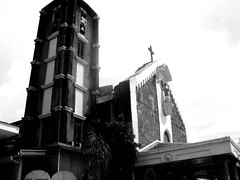
"The Oldest church in town, the Immaculate Concepcion church. It has been renovated many times; its façade (front part) is the only remnants of the original."
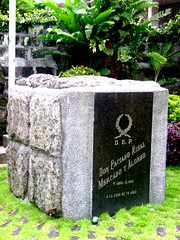
Paciano Rizal's Grave, he was buried in his garden.
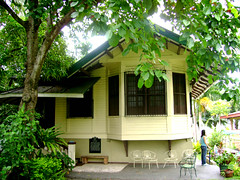
The facade of Paciano's humble house.
View from the Municipio terrace.
Sunday, July 6, 2008
Father Galende and his wonderful books
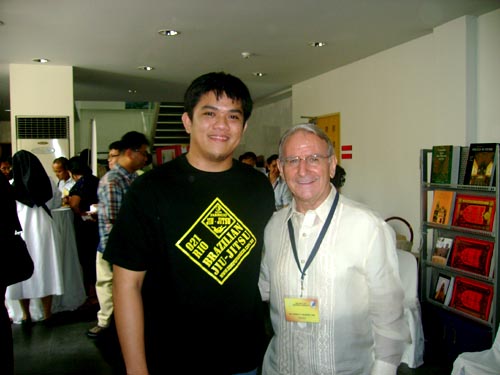
I caught up with Fr. Galende here, I told him that I wanted his autograph but I can't afford his books! promising once I saved enough money I'll get a copy and look for him.
He said with a big smile, "you can always pay me in installments!"
He then told me that he'll sign a copy of mine in a heartbeat, anytime!
---
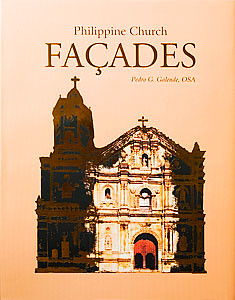
The PHILIPPINE CHURCH FACADE, is such fine book, especially for those who are big fans of baroque churches and old architecture in the land. It contains invaluable background information of when and how this beautiful churches was founded.
One of the books photographer, a blogmate here in the site, is the creator of the blogsite, simbahan.net - great photo guy, Estan. You gotta see his works to admire it.
Fr. Galende has spoke about a second volume for the FACADE's, since there are still hundreds of old churches out there that was not covered in his book. He also hinted working on a feature book on "retablos", now that would be an interesting one.
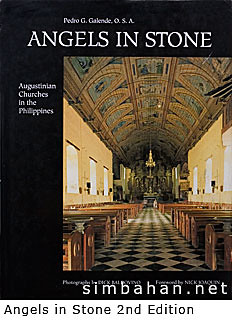
For those who is not familiar with Fr. Pedro Galende, aside from being an author and an Augustinian priest (his other book "Angels of Stone"), he is currently the director of the San Augustin Museum, I believe he's been a Philippine resident for more than two decade now, I just read very recently that he has an MA in English and a PHd in Philo. He speaks perfect english!
One of the people I truly admire, staunch defender of our Filipino heritage, very active in the promotion and of the preservation of cultural and heritage sites. He would always insist to call the style of this old churches as Filipino not Spanish or Mexican, like the other books would put it. For him this creation are uniquely Filipino.
His advocacy is truly inspiring, whenever he speaks about our culture & heritage, he would always do so by using "our", addressing it as one of us. He has embraced our nation as if it was his, we are lucky to have this guy around.
Saturday, July 5, 2008
Why not a salacot for a hat?
During the Urdaneta lectures at the Cervantes, there was this man who kept on interrupting one of the guest speaker, Professor Andrade. That man was introduced as a national artist. So he must be a well-respected man, an expert in the past, since the speaker (not Andrade) was delighted to acknowledge his presence, even after he made a scene out of his loud objections.
Not that I'm rushing to side with Andrade because him being an Arellano figure, which happens to be my Alma mater but because I just find his behaviour as being rude, unprofessional, it was out of line. I see this all the time in town meetings in the US but not here in our land, not with our culture.
It was a lecture - an "open forum" is the event where you can address your question, in his case, his objections- not during the lecture. People are trying to listen, trying to learn from the speaker. The Speaker has the mic, he commands the program. The national artist must have confused the event as a debating challenge, he probably felt privileged, that he can interrupt the program because of his status.
While the professor was citing some of the friar contributions to the country, the national artist shouted, "Are you calling me a liar?" - the notes Andrade gave could've struck a nerve. Then he kept on shouting, "Are you apologizing for them?" I was intrigue to know why this man would act in such a way, it seems that he was offended by what was being discussed obviously.
Andrade being old man, was patient with the angry man, he simply smiled and told the person, "I have it here..." pointing to his folders and continued his lecture. It was odd; there must be a history behind this two people. But if the national artist was simply protesting that this man is paying homage to friar contributions, that is undeniable, in Urdaneta's case successfully plotting the legendary sea's for Spain's ambitions for the Islands, he was in the wrong classroom. The event was for them,the friars, this catholic missionaries who gave so much only to be portrayed as demons in our history books!
There are still academes and students who believe that we would've made it out of the caves without Spain. I have encountered fellow students of history who believes that true Filipinos are the ones untouched by western influence and culture (meaning even he, is not Filipino), some insist that Spain retarded our progress as a true nation. Nationalism in the expense of our true past, as I see it. We can't follow such flawed reviews of our past!
I encourage people to challenge what is being taught in the text books. We can't annul what this friars gave and still use their contributions as if they would've existed even without them being introduced to us.
Culture is not static, is this not the truth?
We should all be objective and see the past as it was, there will always be good and bad, but seeing it that way gives us a balanced view of things. Making it appear all bad so we can feel good about ourselves and hope this would solidify our true identity, well, is not cool.
---
Who is this national artist?
He proudly walks amongst the crowd with his ala Indiana Jones leather hat, which is by the way also a Friar contribution, Sir. I'm referring to the hat and the leather, if one hated Friar contribution so much - why not wear a salacot?
Wednesday, July 2, 2008
Understanding Urdaneta
I was in Instituto Cervantes for the 5th centennial of Fray Andres Urdaneta's birth. There was a series of lectures by prominent academes that focused on the significance of Urdaneta's discovery of a secured route between Asia and the New Spain.
The lecture room was packed with scholars and researchers, being late I stayed outside. Thanks to some good sounding speakers I was able to listen in, even if I was outside, looking in.
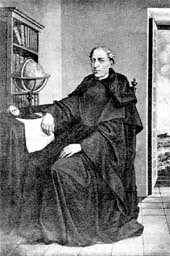
Although I failed to complete the whole program (which started in the morning), catching only last 2 hours or so of the event, I learned a great deal about Urdaneta. I know little of his accomplishments to be honest, since Rizal and the 17th century Philippines is where I concentrated much of my studies. I've read about his breakthrough discovery, his route that enabled Spain to establish settlements and commerce here in those critical days when the other European powers are in a race to find the new world. There was more about the man than I've thought; his life actually, is so colroful that it could be made a Hollywood movie.
Often people I know (including my father) would talk about the bad things that Spain did to us, portrayed as villains and corrupt. I always get ridiculed and made fun of whenever I try to explain the significance of their contributions. Fray Urdaneta contributions is certainly the greatest, for not only that he gave us our name but the route that he created placed our country in the world map, he was, in our modern terms, the pioneer of Filipino globalization.
A navigator and a soldier, the young Urdaneta became part of the Elcano & Loaysa expedition, commissioned to claim the Moluccas for Spain. It failed to achieve its goals, on 1521 almost all but one ship managed to stay up float, Elcano & Loaysa died in the seas, while the only ship that survived the unfortunate ordeal, the one ship that remained, landed in Mindanao. The group was headed by Carquizado, the men was stuck for nine long years in the islands before they managed to head back to Mexico. By this time, the Spice Islands were already under the Portuguese flag.
Urdaneta tried to arrange another campaign to set sail but failed. In 1553 he became a priest under the Augustinian order. His vocation was to focus on catholicizing the native people. When King Phillip ordered de Velasco to attempt to sail back to the islands, they sought the help of the veteran navigator Urdaneta, by now a priest. He declined because of his status, but was later on convinced to take part in the expedition, his majesty granting his conditions.
He wanted not to be in command, that's his condition! Choosing a relative to do so, Legazpi. He hand picked majority of the officers and priest that would embody the mission, most were Basque. The rest is history, when he made contact with the native in the islands; his ability to understand and speak the local dialect came in handy, he convinced the natives to accept their party. The mission to establish a foothold that would be the launching point for the islands evangelization was established. In the years that followed permanent Spanish settlements were realized (including Maynila).
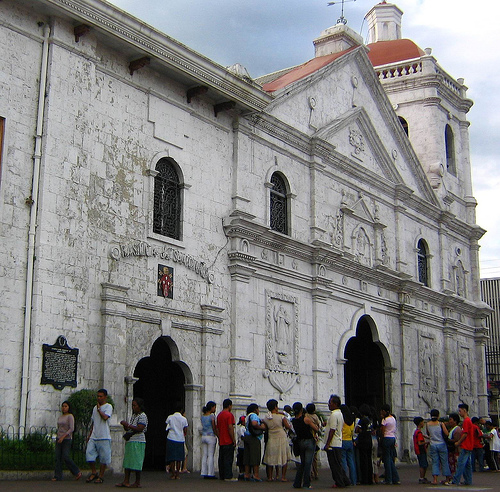
What is not known by many, is that Urdaneta ordered all missionaries to evangelize the natives using their own language. This is one the reason why we kept our regional dialect even with the intense impression of the Spanish colonization. Urdaneta's depth of understanding of the native life led him to make this decision. He presumably understood the importance of communication with the locals using their own language, the impact would be lasting. This could also be the reason why Spanish as a language was not extensively desseminated in the islands during the critical founding years of government, as it was in other Latin countries.
My reflections on the sacrifices and brilliance of Urdaneta was quite an experience. I was right about what I believe and read, history will looks back at this men fairly, they can not be denied of their role in the creation of this country. Although it is a fact that abuses were indeed committed in the years that followed ( they were here for more than 300 years! our President's can't even keep their hands clean with their 6 year term), one could not deny the significance of Spanish governance and the religious work to our land, culture and faith. These were extraordinary men that sought to develop the islands and its people. Much of this contribution has been taken for granted, sometimes I can't help but wonder if our history book intentionally decreased the value of such noble contributions, did it robbed us of the real story or were just a forgetful race.
Some local government has initiated some efforts to recognize Urdaneta's legacy. Urdaneta city would be building a monument of friar, commissioned is national artist Abueva and other artist that would be involved in putting up a piece that would represent the achievements of Urdaneta. The commemoration text would be in English, Spanish, Basque, Ilocano and Panggalatok. This would all be in line with the 500th year celebration of the friars birthday.
Arellano resident scholar Prof. Andrade ended with this reminder, " we should be careful of the past, so we can view the future with hope."
The lecture room was packed with scholars and researchers, being late I stayed outside. Thanks to some good sounding speakers I was able to listen in, even if I was outside, looking in.
Although I failed to complete the whole program (which started in the morning), catching only last 2 hours or so of the event, I learned a great deal about Urdaneta. I know little of his accomplishments to be honest, since Rizal and the 17th century Philippines is where I concentrated much of my studies. I've read about his breakthrough discovery, his route that enabled Spain to establish settlements and commerce here in those critical days when the other European powers are in a race to find the new world. There was more about the man than I've thought; his life actually, is so colroful that it could be made a Hollywood movie.
Often people I know (including my father) would talk about the bad things that Spain did to us, portrayed as villains and corrupt. I always get ridiculed and made fun of whenever I try to explain the significance of their contributions. Fray Urdaneta contributions is certainly the greatest, for not only that he gave us our name but the route that he created placed our country in the world map, he was, in our modern terms, the pioneer of Filipino globalization.
A navigator and a soldier, the young Urdaneta became part of the Elcano & Loaysa expedition, commissioned to claim the Moluccas for Spain. It failed to achieve its goals, on 1521 almost all but one ship managed to stay up float, Elcano & Loaysa died in the seas, while the only ship that survived the unfortunate ordeal, the one ship that remained, landed in Mindanao. The group was headed by Carquizado, the men was stuck for nine long years in the islands before they managed to head back to Mexico. By this time, the Spice Islands were already under the Portuguese flag.
Urdaneta tried to arrange another campaign to set sail but failed. In 1553 he became a priest under the Augustinian order. His vocation was to focus on catholicizing the native people. When King Phillip ordered de Velasco to attempt to sail back to the islands, they sought the help of the veteran navigator Urdaneta, by now a priest. He declined because of his status, but was later on convinced to take part in the expedition, his majesty granting his conditions.
He wanted not to be in command, that's his condition! Choosing a relative to do so, Legazpi. He hand picked majority of the officers and priest that would embody the mission, most were Basque. The rest is history, when he made contact with the native in the islands; his ability to understand and speak the local dialect came in handy, he convinced the natives to accept their party. The mission to establish a foothold that would be the launching point for the islands evangelization was established. In the years that followed permanent Spanish settlements were realized (including Maynila).
What is not known by many, is that Urdaneta ordered all missionaries to evangelize the natives using their own language. This is one the reason why we kept our regional dialect even with the intense impression of the Spanish colonization. Urdaneta's depth of understanding of the native life led him to make this decision. He presumably understood the importance of communication with the locals using their own language, the impact would be lasting. This could also be the reason why Spanish as a language was not extensively desseminated in the islands during the critical founding years of government, as it was in other Latin countries.
My reflections on the sacrifices and brilliance of Urdaneta was quite an experience. I was right about what I believe and read, history will looks back at this men fairly, they can not be denied of their role in the creation of this country. Although it is a fact that abuses were indeed committed in the years that followed ( they were here for more than 300 years! our President's can't even keep their hands clean with their 6 year term), one could not deny the significance of Spanish governance and the religious work to our land, culture and faith. These were extraordinary men that sought to develop the islands and its people. Much of this contribution has been taken for granted, sometimes I can't help but wonder if our history book intentionally decreased the value of such noble contributions, did it robbed us of the real story or were just a forgetful race.
---
Some local government has initiated some efforts to recognize Urdaneta's legacy. Urdaneta city would be building a monument of friar, commissioned is national artist Abueva and other artist that would be involved in putting up a piece that would represent the achievements of Urdaneta. The commemoration text would be in English, Spanish, Basque, Ilocano and Panggalatok. This would all be in line with the 500th year celebration of the friars birthday.
Arellano resident scholar Prof. Andrade ended with this reminder, " we should be careful of the past, so we can view the future with hope."
Subscribe to:
Comments (Atom)